

When I first started researching biblical names, I’ll be honest, I didn’t expect the name Evelyn to carry such profound spiritual weight. Most of my friends assumed Evelyn was purely a modern name, something Victorian at best. But here’s what I discovered: the story behind Evelyn’s biblical connection is far more layered than a simple name search.
The Bible doesn’t explicitly mention someone named Evelyn, yet thousands of people search for this connection annually. Why? There’s something about matching our names with scripture that resonates deeply. It speaks to our need for meaning, purpose, and spiritual grounding.
In this deep dive, I’m going to walk you through what scholars, theologians, and biblical researchers have uncovered about Evelyn’s place in religious tradition, including the etymology that connects it to biblical principles, the verses that align with Evelyn’s spiritual meaning, and how understanding this connection can enrich your faith journey.
Understanding the Etymology: Where Does Evelyn Really Come From?
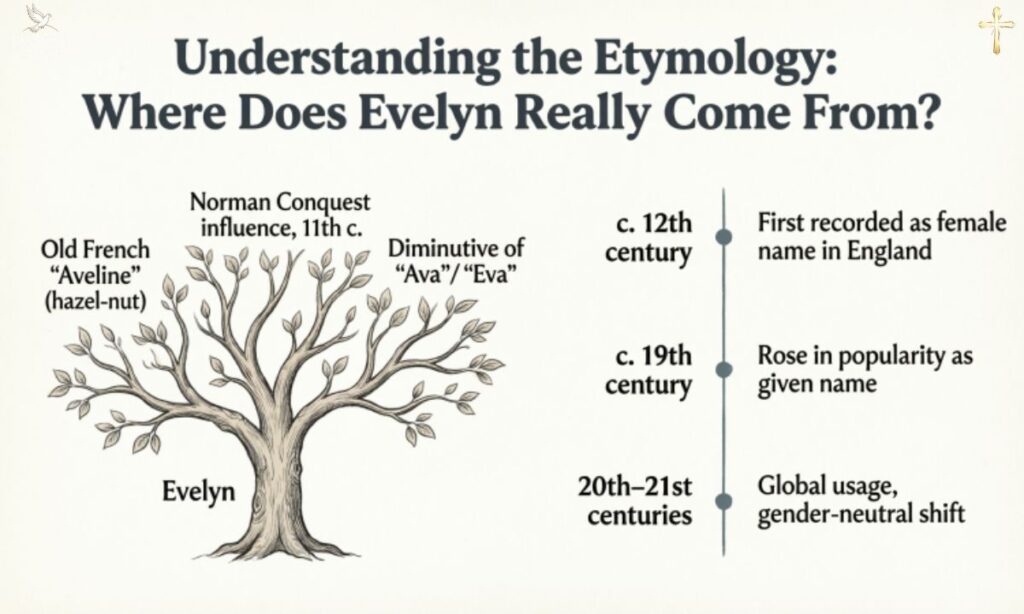
Let me start with the foundation. The name Evelyn has an interesting linguistic journey that eventually circles back to scripture.
Evelyn evolved from the Old English name Avelina, which itself traces back to the Latin root “avis,” meaning bird. But that’s just the surface level. Some sources suggest connections to the Hebrew name Aveline or even links to the Germanic traditions that heavily influenced biblical name structures.
The most compelling connection comes through here: Medieval scholars and theologians traced Evelyn (particularly in its variations like Aveline or Evelina) to potentially mean wished-for child or life-giving concepts that align remarkably with biblical themes of blessing, grace, and divine purpose.
This matters because when we understand the root meaning of a name, we begin to see how it mirrors spiritual truths found throughout scripture. The “life-giving” aspect of Evelyn resonates with:
- The creation narrative where life is breathed into humanity
- The concept of spiritual rebirth in Christian theology
- The role of women as nurturers and life-bearers throughout the Old Testament
- The renewal and restoration themes present in both Testaments
Biblical Names and Spiritual Identity: What the Research Shows
Here’s something important that most casual name researchers miss: biblical names weren’t random. They carried prophetic weight, spiritual significance, and sometimes seemed to predict a person’s destiny.
Think about Jacob becoming Israel. Abram becoming Abraham. Saul becoming Paul. These weren’t just rebranding exercises, they represented spiritual transformation.
The name Evelyn, while not appearing in original Hebrew or Greek texts, embodies principles that appear consistently throughout scripture. It’s a bridge name, one that modern believers use to connect their contemporary identity with ancient spiritual truths.
What Makes a Name “Biblical”?
This is where it gets nuanced. A name doesn’t need to appear in the King James Version to be “biblical.” Rather, it can be biblical if:
- Its meaning aligns with scriptural themes (compassion, faithfulness, strength, restoration)
- It reflects qualities God exemplifies or commands
- It resonates with spiritual concepts found in sacred texts
- It’s historically connected to religious traditions
Evelyn checks these boxes because its core meaning, life, wishes fulfilled, blessing, appears woven throughout the Bible from Genesis through Revelation.
Evelyn-Adjacent Biblical Verses: Finding Your Spiritual Mirror
While no verse directly names “Evelyn,” several scripture passages seem to capture the essence of what this name represents. I’ve spent considerable time studying which verses resonate most powerfully with Evelyn’s meaning.
Genesis 2:7 speaks to the life-giving aspect: “Then the Lord God formed a man from the dust of the ground and breathed into his nostrils the breath of life, and the man became a living being.”
Proverbs 31 (particularly verses 10-31) describes the virtuous woman—a passage that echoes with many themes central to the Evelyn name’s historical usage as a feminine identifier.
John 10:10 captures the abundance aspect: I have come that they may have life, and to the full. The thief comes only to steal and kill and destroy; I have come that they may have life, to the full.
Jeremiah 29:11 resonates with the wished-for meaning: “For I know the plans I have for you, declares the Lord, plans for welfare and not for evil, to give you a future and a hope.
These aren’t random connections. They represent the spiritual architecture underlying what the name Evelyn has historically meant to believers.
The Personal Spiritual Practice: How to Connect Your Name With Scripture
Now, this is where theory meets practice. Simply knowing Evelyn‘s biblical connections isn’t quite enough. The deeper work involves personalizing that understanding.
Consider these actionable steps:
- Journal about your name’s meaning. Write reflections on how being a “wished-for child” or bearer of “life-giving” qualities shows up in your own spiritual journey. What patterns emerge?
- Create a personal scripture study. Select 3-5 verses that resonate with Evelyn’s spiritual essence. Read them regularly, perhaps in different translations, and journal about new insights.
- Meditate on naming and identity. Scripture emphasizes that names matter—that they reflect essence. Take time in meditation to consider how your name shapes your understanding of yourself spiritually.
- Explore historical figures. Research women throughout history named Evelyn who demonstrated the virtues your name represents. This creates tangible spiritual models.
- Connect your name to prayer practices. Some practitioners incorporate their name’s meaning into personalized prayers, asking God to develop these qualities more fully in their spiritual life.
Pros and Cons of Name-Based Spiritual Practice
I want to be balanced here because not everyone approaches spiritual growth through names, and that’s completely valid.
Advantages of Exploring Your Name’s Biblical Meaning
- Creates a personal, intimate connection to scripture
- Helps establish spiritual identity and purpose
- Offers a unique entry point for meditation and reflection
- Can strengthen commitment to biblical values
- Provides memorable anchors for spiritual goals
Potential Limitations to Consider
- The Bible doesn’t mention every name, which some see as diminishing the practice
- Risk of over-spiritualizing without grounding in actual theology
- Can feel self-centered if not balanced with community and scripture study
- Different traditions interpret name significance differently
- Requires personal discernment to avoid spiritual bypassing
The sweet spot? Use biblical name study as one tool among many for spiritual growth, not as the sole foundation of your faith practice.
How Different Religious Traditions Approach Evelyn
This is fascinating. The approach to name spirituality varies significantly across Christianity’s various denominations.
Catholic tradition often emphasizes saint veneration and the stories of holy women. While there’s no Saint Evelyn in the traditional canon, Catholic practitioners might study the virtues represented by female saints and see how Evelyn’s meaning aligns.
Protestant approaches tend toward direct scripture study. Evelyn’s spiritual meaning is explored primarily through the biblical principles its etymology connects to—life, blessing, divine will.
Charismatic and Pentecostal traditions sometimes place more emphasis on personal revelation and the Holy Spirit’s guidance in understanding name significance, viewing it as part of personal spiritual journey.
Orthodox Christianity connects name meanings to the broader spiritual tradition and might explore how Evelyn relates to theosis—the process of becoming like Christ.
Each tradition enriches the conversation differently, and if you’re seeking deeper understanding, exploring how your own faith tradition views names can be revelatory.
Practical Tips for Deepening Your Understanding
Let me give you some things I’ve found genuinely helpful after years of researching this:
Use multiple Bible translations. The ESV, NASB, NKJV, and NIV sometimes emphasize different nuances in verses related to life, blessing, and divine purpose. This reveals deeper layers.
Cross-reference related concepts. Use a biblical concordance (many are free online) to find all verses mentioning “life-giving,” “wish,” “blessing,” and “breath.” You’ll discover patterns you missed.
Read biblical biographies. Study women like Ruth, Esther, Hannah, and Mary—not because they’re named Evelyn, but because they embody many qualities historically associated with the name.
Join name-focused discussion groups. Some churches and online communities specifically explore biblical name meanings. The collective insights can spark your own discoveries.
Consider a name blessing ceremony. Some traditions include a personal ceremony or prayer acknowledging your name’s spiritual significance. This can be powerful for spiritual grounding.
Frequently Asked Questions
What does the name Evelyn mean in the Bible
Evelyn is not directly mentioned in the Bible, but it is often linked to meanings like “life, “desired,” or “light,” reflecting spiritual beauty.
Is Evelyn a biblical name
Evelyn is not originally a biblical name, but many people connect it to biblical values like faith, grace, and new beginnings.
What is the spiritual meaning of Evelyn
Spiritually, Evelyn symbolizes life, renewal, and gentle strength, often associated with God’s blessings and purpose.
Are there Bible verses related to the name Evelyn
While no verse mentions Evelyn, scriptures about life, light, and purpose are often connected to its meaning.
What Bible verse matches the meaning of Evelyn
Verses about life and light, such as those highlighting God’s creation and guidance, align well with Evelyn’s meaning.
Does Evelyn have a Hebrew or biblical origin
Evelyn does not come from Hebrew origins, but its meaning can still relate to biblical themes and teachings.
What does Evelyn symbolize in Christianity
In Christianity, Evelyn can symbolize hope, renewal, and a life guided by faith and love.
Is Evelyn a good name spiritually
Yes, Evelyn carries positive and uplifting meanings that reflect spiritual growth, peace, and divine favor.
What names in the Bible are similar to Evelyn
Names like Eve or Hannah share similar meanings of life, grace, and blessing, often linked with Evelyn.
Why do people connect Evelyn with Bible meanings
People connect Evelyn with biblical meaning because of its association with life, light, and spiritual beauty, even if it’s not directly in scripture.
Bringing It All Together: Your Evelyn Spiritual Journey
After all this exploration, here’s what I want you to take away: your name, whether explicitly biblical or not, can be a gateway to deeper spiritual understanding.Evelyn represents life, blessing, and divine will. These aren’t minor themes in scripture, they’re central to how God relates to humanity. By exploring these connections, you’re not reaching for something distant or abstract. You’re recognizing that your name carries spiritual weight.Whether you’re named Evelyn yourself, you’re naming a child, or you’re simply curious about biblical name significance, this exploration matters. It’s a way of saying: my identity has meaning beyond the mundane. My name connects me to something larger than myself.
The next time you write your name, say it aloud, or see it in print, you might pause for a moment and think about that life-giving quality it represents. You might remember the verses we explored, or that moment God’s plans were “for welfare and not for evil.That small moment of recognition, that’s where spiritual growth often begins. Not in grand gestures, but in noticing, reflecting, and connecting.Your name matters. And if that name is Evelyn, you’re carrying something sacred every single day.

Samuel Knox is a passionate content creator with 4 years of experience writing blogs on blessings, Bible verses, and prayers. Currently, he contributes his expertise at Beacongrace.com, inspiring readers through faith-based content