

If you have ever come across the name Atticus and wondered whether it appears somewhere in the pages of Scripture, you are not alone. It is a striking name, strong, classical, and carrying a certain gravity that feels almost ancient. Many people stumble upon it in a novel, a history book, or even a genealogy record and naturally start asking whether it has any connection to the Bible or to early Christian tradition.
The honest answer is both simple and surprisingly rich. Atticus does not appear in the canonical books of the Bible as we know them today. But the story does not end there. The name carries deep historical weight, intersects meaningfully with early Christian history, and reflects a fascinating chapter in how names, cultures, and faith traditions have overlapped across the centuries. Understanding what Atticus means, and where it truly belongs, can actually open a thoughtful window into the ancient world from which the Bible itself emerged.
Is Atticus Mentioned in the Bible?

Let us be clear from the start: the name Atticus does not appear anywhere in the canonical Bible. Whether you search the Old Testament or the New Testament, in Hebrew, Greek, or any of the major English translations, you will not find a person named Atticus listed among the disciples, prophets, kings, or early church figures.
This surprises some people because the name sounds ancient and carries the kind of gravitas associated with biblical-era figures. The confusion usually arises from a few different sources: the name’s obvious classical roots, its presence among early church leaders who lived around the same time as the apostles, and the tendency of readers to associate any ancient-sounding name with Scripture.
Some readers may also encounter Atticus in apocryphal texts or early patristic writings documents written by church fathers in the first few centuries after Christ. These are not part of the biblical canon recognized by most Christian traditions, but they are historically significant. The name appears in those circles, which may be another reason it feels vaguely biblical to modern ears.
It is also worth noting that certain names were common across the Roman world during the first century, and the New Testament does include several Roman names. Figures like Claudius, Felix, Festus, and Cornelius appear in the New Testament because the story of early Christianity unfolded inside the Roman Empire. Atticus would have fit right alongside them, it simply never made it into the canonical text.
Meaning and Origin of the Name Atticus
The name Atticus comes from the Latin word Atticus, which itself derives from the Greek Attikos. This adjective means “belonging to Attica, the region of ancient Greece that surrounds Athens. In other words, the name essentially meant man of Attica or, more loosely, Athenian.
Attica was not just any region. It was the intellectual and cultural heartland of ancient Greece, home to Socrates, Plato, Aristotle, and the great tradition of philosophical inquiry. To be called Attic in the ancient world carried a connotation of refinement, learning, and eloquence. The term Attic Greek even became synonymous with the purest and most elegant form of the Greek language.
So when a person was called Atticus, the name carried subtle but real associations with wisdom, education, and high culture. It was a name that parents gave to sons they hoped would be thoughtful and learned. In Roman society, where Greek culture was both admired and imitated, naming a child Atticus was a mark of intellectual aspiration and social sophistication.
The name remained in use across both the Greek-speaking East and the Latin-speaking West of the Roman Empire, which is why it shows up in different contexts, philosophical, political, and eventually ecclesiastical.
Atticus in Historical and Early Christian Context
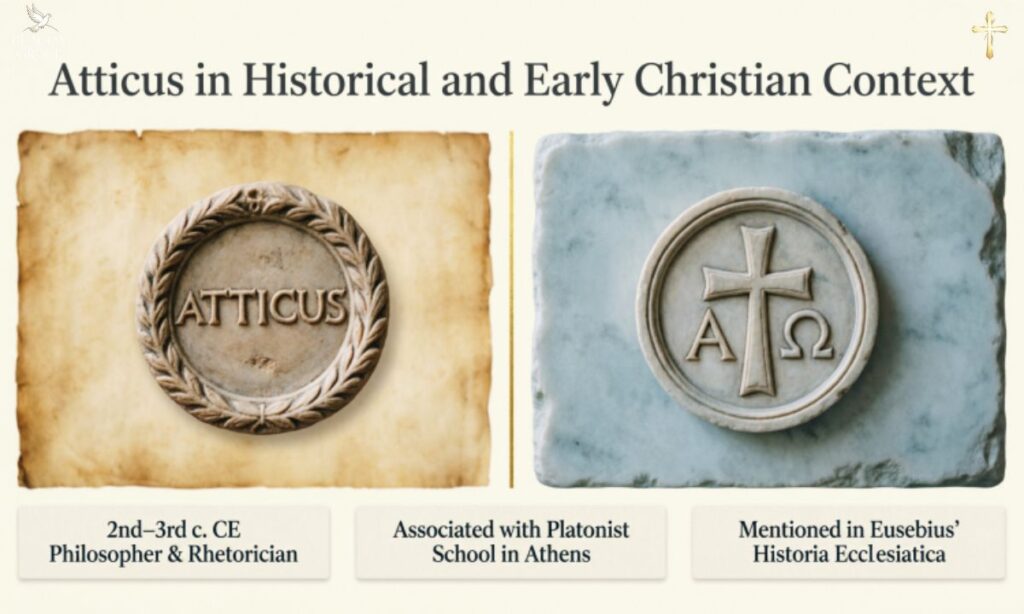
Even though Atticus is not a biblical name, it is very much a name that belongs to the world the Bible was written in and for. Understanding a few key historical figures named Atticus helps clarify the name’s true significance.
Titus Pomponius Atticus
Perhaps the most famous person to bear this name in the ancient world was Titus Pomponius Atticus, a Roman literary patron and the lifelong friend of the great orator Marcus Tullius Cicero. Atticus, and he was so widely known by this cognomen that it essentially became his name as a wealthy, educated Roman who lived from 110 to 32 BC.
He was known for his love of Athens (hence his nickname), his remarkable political neutrality during Rome’s turbulent civil wars, and his deep friendship with Cicero, documented in hundreds of surviving letters. He was a man of peace, letters, and refinement in an era of violence and ambition. His name became almost a byword for the cultured, thoughtful Roman gentleman.
While he lived before the time of Christ, his legacy helps explain why the name Atticus carried such weight in the centuries that followed. Early Christians, many of whom were educated Romans or Greek speakers, would have recognized the cultural resonance of this name.
Atticus of Constantinople
Perhaps more directly relevant to Christian history is Atticus of Constantinople, who served as the Patriarch of Constantinople from approximately 406 to 425 AD. He was a significant figure in the early church, involved in the controversies that followed the exile of John Chrysostom and the theological debates of his era.
Atticus of Constantinople was not simply an administrator. He played an active role in reconciling factions within the church, worked to restore communion with various bishops, and governed one of the most important sees in the Christian world during a period of tremendous theological and political complexity. His tenure coincided with the final consolidation of the New Testament canon and the great ecumenical councils that shaped Christian doctrine for all time.
He is a reminder that by the fifth century, Christians were confidently using names like Atticus, names drawn from Greek and Roman culture, without any sense of contradiction with their faith. In fact, this was entirely natural.
How Roman and Greek Names Were Used by Early Christians
The early church was born inside the Roman Empire, and its members came from every corner of that world. Jewish names like Simon, Mary, and Joseph mingled freely with Greek names like Philip, Andrew, and Lydia, and with Latin names like Fortunatus, Quartus, and Tertius. Paul himself bore both a Hebrew name (Saul) and a Roman name (Paul), and he switched between them depending on his audience.
As Christianity spread through the empire, converts brought their existing names with them. Nobody was required to change their name upon baptism in this early period. So a Roman man named Atticus who converted to Christianity simply remained Atticus. Over time, the church community developed its own naming traditions, but even these drew heavily on the same Greek and Latin pool that produced names like Atticus.
This means that Atticus, while not biblical, is genuinely a name of the era of the Bible, a name that could have easily belonged to one of the unnamed believers Paul greeted in his letters or one of the converts Luke mentioned in the book of Acts.
Is Atticus the Same as Atticus Finch?

When many modern readers hear the name Atticus, their minds travel not to ancient Greece or the early church but to a small town in Alabama in the 1930s. Atticus Finch is, of course, the beloved protagonist of Harper Lee’s novel To Kill a Mockingbird, published in 1960 and widely considered one of the great American novels.
Atticus Finch is a lawyer, a widower, and a father who defends a Black man falsely accused of a serious crime in the deeply segregated American South. He became a cultural symbol of moral courage, integrity, and justice, qualities that, interestingly, resonate with the ancient associations of his name.
There is no biblical connection here. Atticus Finch is a fictional character from twentieth-century American literature, not a figure from Scripture or early church history. Harper Lee chose the name deliberately. It has the gravity and classical weight that suits a character meant to embody timeless moral virtues. But “Is Atticus a biblical name” is not a question that Atticus Finch can answer, his story lives entirely within the world of modern fiction.
What is worth noting is that the enduring appeal of the name Atticus in literature and in baby name books today often has as much to do with Atticus Finch as with any ancient source. For many parents naming their children Atticus today, it is the fictional lawyer from Maycomb, Alabama, rather than the Patriarch of Constantinople, who lingers in mind.
Rare and Overlooked Names in the Bible
The Bible is full of names that most readers have never paused to consider. Some appear only once, in a single verse, attached to a person whose story is barely sketched. Yet each of them carries a lesson or a significance worth exploring. Here are a few that deserve more attention.
Demas
Demas is mentioned three times in the New Testament, briefly in Colossians and Philemon as a fellow worker of Paul, and then devastatingly in 2 Timothy 4:10, where Paul writes that Demas has deserted him, having loved this present world. In just a few words, Demas becomes a cautionary figure about the dangers of worldly attachment pulling a believer away from faithfulness. His name, derived from the Greek demos (meaning people or populace), ironically belongs to a man who could not stand apart from the crowd.
Philetus
Philetus appears only in 2 Timothy 2:17, alongside a man named Hymenaeus. Paul identifies them as teachers who have strayed from the truth, claiming that the resurrection has already taken place and upsetting the faith of some believers. Philetus, whose name comes from the Greek word for beloved or amiable, stands as a warning that charm and likability are no guarantees of sound doctrine. A beloved teacher who teaches falsehood causes more damage, not less.
Bar-Jesus
Bar-Jesus, also called Elymas the sorcerer, appears in Acts 13:6-12 as an opponent of the apostle Paul during his mission to the island of Cyprus. The name Bar-Jesus means son of Jesus or son of Joshua, a deeply ironic title for a man who actively opposed the Gospel. When Paul confronted him, he was temporarily struck blind. His story illustrates how even a name associated with salvation is no substitute for an actual encounter with truth.
Each of these figures, obscure as they are, reflects something enduring about human nature, the pull of the world, the danger of false teaching, and the irony of wearing a sacred name while opposing sacred things.
Spiritual Symbolism of the Name Atticus
Even though Atticus does not appear in Scripture, the values embedded in its meaning are deeply resonant with biblical themes. The name is historically associated with wisdom, eloquence, learning, and justice, and each of these values runs like a thread through the entire biblical narrative.
Wisdom, in both the Old and New Testaments, is not merely intellectual but moral. The book of Proverbs opens with an invitation to gain wisdom and understanding. James 1:5 promises that God gives wisdom generously to those who ask. The Athenian roots of the name Atticus, pointing toward the philosophical tradition of Socrates and Plato, remind us that the pursuit of truth is itself a form of worship.
Justice is arguably the most persistent theme in the Hebrew prophets. Micah’s famous call, to do justice, love mercy, and walk humbly, echoes across centuries. Atticus Finch, whatever his fictional origins, embodied a version of that call in his courtroom defense of the innocent. The spiritual symbolism of the name points toward a life lived in pursuit of what is right, even when it is costly.
Intellect in the service of faith has always been honored in Christian tradition. Paul debated in the synagogues and the Areopagus. Augustine brought the tools of classical philosophy to Christian theology. The great Christian thinkers of every century were people who used their minds as instruments of devotion. A name that points toward Attica, toward the intellectual heart of the ancient world, is not out of place in that tradition.
Key Takeaways
- Atticus does not appear in the canonical Bible, in either the Old or New Testament.
- The name comes from Greek and Latin roots, meaning “of Attica” the region surrounding Athens in ancient Greece.
- It carries historical associations with wisdom, eloquence, refinement, and learning.
- Titus Pomponius Atticus, the Roman literary patron and friend of Cicero, is the most famous ancient bearer of the name.
- Atticus of Constantinople was a real early Christian leader who served as patriarch in the fifth century AD.
- Early Christians routinely used Greek and Roman names, so Atticus fits naturally in that world even without appearing in Scripture.
- Atticus Finch from “To Kill a Mockingbird” is a fictional character and has no connection to biblical or early Christian history.
- The values associated with the name, wisdom, justice, and intellectual integrity, are deeply biblical in spirit, even if the name itself is not scriptural.
- The Bible contains many rare and overlooked names, each carrying its own lesson for those willing to look closely.
Frequently Asked Questions
Is Atticus a biblical name
No, Atticus is not a biblical name. It does not appear in any canonical book of the Old or New Testament. It is a name of Greek and Latin origin that was common in the ancient Roman world during and after the time of the New Testament.
What does the name Atticus mean in the Bible
Since Atticus does not appear in the Bible, it carries no direct biblical meaning. However, its root meaning of Attica or Athenian suggests associations with wisdom and learning that align broadly with biblical values.
Was there a Christian leader named Atticus
Yes. Atticus of Constantinople served as Patriarch of Constantinople from around 406 to 425 AD. He was an important early church leader, though he lived after the biblical canon was largely established and does not appear in Scripture.
Could someone in the New Testament have been named Atticus
It is historically plausible. Many early Christians bore Greek and Roman names, and Atticus was a recognized name in that world. However, no person named Atticus is identified in the New Testament text itself.
Is Atticus a Christian name
It has been used by Christians throughout history, including by church leaders like Atticus of Constantinople. While it is not inherently a Christian name in the way that names like Peter or Mary are, it belongs comfortably within the Christian tradition.
Who was Titus Pomponius Atticus
He was a wealthy Roman scholar and literary patron who lived from 110 to 32 BC, most famous as the lifelong friend of the orator Cicero. He earned the name Atticus because of his deep love for Athens and Greek culture.
Is Atticus Finch related to the Bible
No. Atticus Finch is a fictional character from Harper Lee’s novel “To Kill a Mockingbird. He is not based on any biblical figure, and the novel has no religious origin for the name. The name was chosen for its classical resonance, not its scriptural connections.
What are some actual rare names in the Bible
The Bible contains many overlooked names, including Demas (a deserter mentioned in 2 Timothy), Philetus (a false teacher), and Bar-Jesus (a sorcerer who opposed Paul). Each appears briefly but carries a meaningful lesson.
Why do some people think Atticus is in the Bible
The confusion likely comes from the name’s ancient sound, its use by early Christian leaders in patristic writings, and the general tendency to associate classical names with biblical culture. The fact that the early church existed entirely within the Roman world adds to this natural overlap.
Is Atticus a good name for a Christian child
That is a personal decision, of course. Many Christian parents choose names based on meaning, heritage, and the values they wish to pass on. Atticus, with its associations with wisdom, learning, and justice, carries values that are entirely consistent with Christian teaching, even if the name itself is not drawn from Scripture.
Conclusion
The name Atticus is not found in the Bible, but it belongs unmistakably to the world the Bible came from. It is a name forged in the intellectual and cultural heart of ancient Greece, carried through centuries of Roman history, adopted naturally by early Christians, and eventually passed down to modern readers through literature and tradition alike. Searching for Atticus in the pages of Scripture will not yield a result, but searching for what the name stands for will lead you somewhere far richer.
Wisdom. Justice. The pursuit of truth in a world that often resists it. These are not foreign ideas to the biblical tradition. They run through the prophets, through the Proverbs, through the letters of Paul, and through the life of Christ himself. A name need not appear in the canon to carry values that the canon affirms. Atticus reminds us that the ancient world was vast and interconnected, that faith and culture have always shaped each other, and that sometimes the most honest answer to a question opens a door worth walking through.

Samuel Knox is a passionate content creator with 4 years of experience writing blogs on blessings, Bible verses, and prayers. Currently, he contributes his expertise at Beacongrace.com, inspiring readers through faith-based content