

There’s something profoundly transformative that happens when we truly understand thanksgiving. I’m not talking about the turkey and stuffing kind of thanksgiving, though I love those traditions as much as anyone. I’m talking about the kind of gratitude that rewires our hearts, the kind that makes us see God’s fingerprints on every moment of our lives.
You see, gratitude isn’t just a polite response to blessing. It’s a spiritual discipline that changes us from the inside out. When the apostle Paul wrote from a Roman prison cell, chained and uncertain of his future, he didn’t complain. He didn’t demand answers. Instead, he wrote, “Rejoice in the Lord always. I will say it again: Rejoice, That’s not denial, that’s the power of a grateful heart that refuses to be imprisoned by circumstances.
I’ve watched gratitude transform marriages on the brink of divorce. I’ve seen it restore hope to people battling depression. I’ve witnessed it turn ordinary believers into extraordinary witnesses for Christ. Why? Because thankfulness shifts our gaze from what we lack to what we have, from our problems to God’s provision, from our weakness to His strength.
The enemy of our souls knows this truth, which is why he works overtime to keep us focused on complaints, comparisons, and discontent. But when we choose gratitude, and it is a choice, we step into a realm of spiritual authority that darkness cannot touch. We align ourselves with heaven’s perspective. We declare that God is good, even when life is hard.
These thirty sermon outlines are designed to help you cultivate this kind of deep, transformative gratitude in your congregation. Each message is crafted to touch the heart, challenge the mind, and equip God’s people to live as thankful witnesses in a world that desperately needs to see the joy of the Lord. Use them with prayer, adapt them to your context, and watch as the spirit of thanksgiving transforms your church family from the inside out.
When Gratitude Feels Impossible: Thanking God in the Wilderness
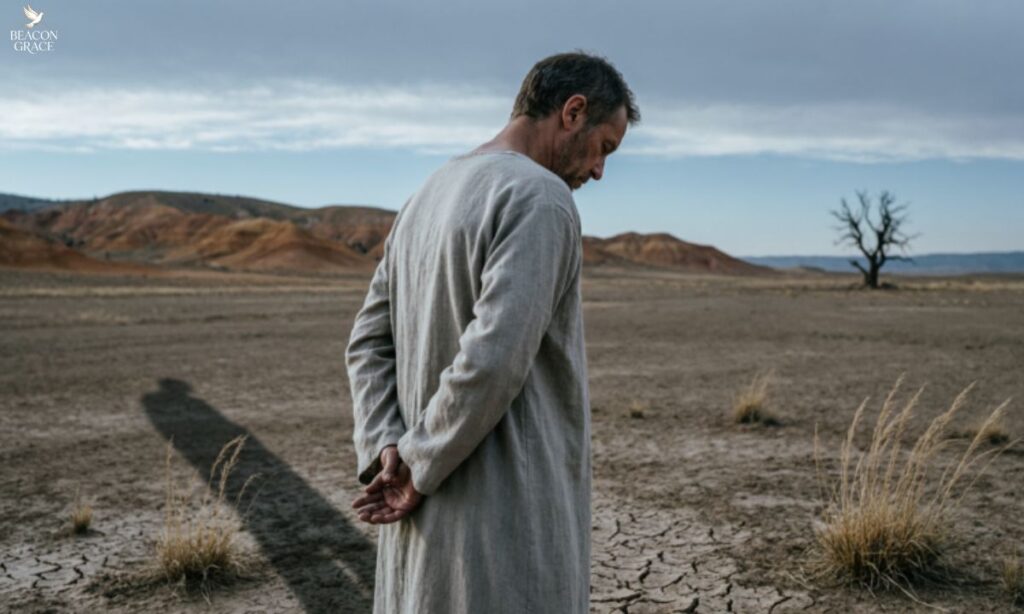
Theme: Finding reasons to thank God even when circumstances are painful
Key Bible Verse: Though the fig tree does not bud and there are no grapes on the vines, though the olive crop fails and the fields produce no food, though there are no sheep in the pen and no cattle in the stalls, yet I will rejoice in the Lord, I will be joyful in God my Savior. Habakkuk 3:17-18
Core Message: True gratitude is tested not in abundance but in scarcity. When everything around us crumbles, our thanksgiving becomes a declaration of faith that God Himself is enough. This kind of gratitude doesn’t deny reality, it transcends it by anchoring our hope in God’s unchanging character rather than our changing circumstances.
Sample Mini Sermon:
Let me paint you a picture. The prophet Habakkuk stood surveying absolute devastation. No crops. No livestock. No food. No hope, at least not from an earthly perspective. Everything that represented security, provision, and future had been stripped away. And in that moment of complete loss, he made a choice that still echoes through the ages: Yet I will rejoice in the Lord.
That word still carries tremendous weight. It’s the hinge between despair and hope. It’s the choice to look beyond what we can see with our eyes to what we know in our spirits. Habakkuk didn’t pretend everything was fine. He catalogued his losses honestly. But he refused to let those losses have the final word.
I’ve sat with people in hospital rooms where diagnoses felt like death sentences. I’ve counseled families as they buried loved ones far too young. I’ve walked alongside believers who lost jobs, homes, and dreams. And here’s what I’ve discovered: the people who survive these wilderness seasons with their faith intact are the ones who learn to say yet.
I don’t understand why this happened, yet I trust God’s heart. I can’t see a way forward, yet I know God makes a way. This pain is real, yet God’s presence is more real.
This isn’t toxic positivity. This is warfare. When we choose gratitude in the wilderness, we’re declaring to every spiritual force that our God is worthy of praise regardless of our circumstances. We’re testifying that He alone satisfies, that His character doesn’t change with our comfort level, that His goodness isn’t measured by our good fortune.
The enemy wants us to believe that gratitude is only appropriate when life is comfortable. But Scripture shows us something radically different. Our most powerful thanksgiving rises from the ashes of our deepest pain, declaring that God is good even here, even now, even when nothing makes sense.
Weekly Challenge: Identify one painful circumstance in your life right now. Instead of asking God to change it, thank Him for one way He’s present in it.
The Gratitude That Heals: Thankfulness as Spiritual Medicine
Theme: How gratitude heals emotional and spiritual wounds
Key Bible Verse: A cheerful heart is good medicine, but a crushed spirit dries up the bones. Proverbs 17:22
Core Message: Medical science confirms what Scripture has always taught, gratitude heals. When we cultivate thankfulness, we’re not just being polite; we’re releasing healing into our bodies, minds, and spirits. Gratitude lowers anxiety, reduces depression, strengthens immunity, and restores joy. It’s medicine for the soul that God prescribed long before modern research proved its effectiveness.
Sample Mini Sermon:
I want to share something that changed my understanding of gratitude forever. Years ago, I was going through a season of profound discouragement. Ministry was hard, relationships were strained, and I felt like I was failing at everything that mattered. My doctor noticed my stress levels were affecting my physical health, and she said something unexpected, Pastor, you need to practice gratitude. It’s not just spiritual advice, it’s a medical necessity.
She explained that chronic stress and negativity flood our systems with cortisol, weakening our immune response and accelerating aging. But gratitude? Gratitude triggers the release of dopamine and serotonin, the same neurotransmitters that antidepressants target. It literally rewires our brains toward hope and resilience.
Solomon knew this three thousand years ago when he wrote that a cheerful heart is good medicine. God designed our bodies to thrive in gratitude and wither in complaint. Think about that. The Creator of the universe built healing into the simple act of saying thank you.
So I started practicing. Every morning before my feet hit the floor, I would name five specific things I was grateful for. Not generic things, specific things. Thank you for the way my wife smiled at me yesterday. Thank you for the phone call from my son. Thank you for the sunset I noticed on my drive home. Thank you for the sermon idea that came during prayer. Thank you for the strength to get through yesterday.
And something shifted. Not overnight, but gradually. My perspective changed. The same challenges were still there, but they looked different through grateful eyes. The weight I’d been carrying began to lift. My energy returned. Hope flickered back to life.
Gratitude isn’t denial. I wasn’t pretending my problems didn’t exist. I was choosing to focus on what was good, true, and beautiful alongside what was difficult. And in that choice, healing began.
Weekly Challenge: Start a gratitude journal. Write five specific things you’re thankful for each morning before checking your phone.
Grateful for Unanswered Prayers: Trusting God’s “No”

Theme: Finding gratitude for prayers God doesn’t answer the way we want
Key Bible Verse: For my thoughts are not your thoughts, neither are your ways my ways, declares the Lord. As the heavens are higher than the earth, so are my ways higher than your ways and my thoughts than your thoughts. Isaiah 55:8-9
Core Message: Some of our greatest blessings come disguised as unanswered prayers. God’s wisdom infinitely surpasses our understanding, and His “no” is often His greatest mercy. Learning to thank God for closed doors requires mature faith that trusts His heart even when we can’t trace His hand.
Sample Mini Sermon:
I have a friend who prayed desperately for years to marry a particular person. She was convinced this was God’s will. She fasted, she prayed, she believed with everything in her. And the door stayed closed. She was heartbroken, angry even. She questioned God’s goodness and His love for her.
Five years later, she met and married someone else. And here’s what she told me recently: Thank God He didn’t answer that prayer. I was so blind. That relationship would have destroyed me. I wanted what I wanted so badly that I couldn’t see what God could see. His ‘no’ was the most loving thing he ever did for me.
How many of us can look back and see the same pattern? We begged God for something that would have hurt us. We demanded doors to open that He mercifully kept closed. We threw tantrums when He said no, not realizing He was protecting us from disaster.
Isaiah reminds us that God’s ways are higher than ours, not just different, but higher. Better. Wiser. He sees the whole story while we’re stuck in one chapter. He knows the ending while we’re struggling through the middle. He understands consequences we can’t possibly foresee.
This doesn’t make unanswered prayers easy. Grief over what we don’t receive is real and valid. But it does invite us into a deeper trust. Can we thank God not just for what He gives but for what He withholds? Can we believe that His timing is perfect, even when it’s painful? Can we rest in the knowledge that He loves us too much to give us everything we ask for?
Mature gratitude says, God, I don’t understand why you said no. I’m disappointed. I’m confused. But I trust that you see what I can’t see, and I’m choosing to thank you for your wisdom, even when it breaks my heart.
Weekly Challenge: Identify one prayer God hasn’t answered the way you wanted. Thank Him for His wisdom in that situation, even if you don’t understand it yet.
The Gratitude of Dependence: Thanking God for Our Limitations
Theme: Finding thankfulness in our weaknesses and need for God
Key Bible Verse: But he said to me, ‘My grace is sufficient for you, for my power is made perfect in weakness’ Therefore I will boast all the more gladly about my weaknesses, so that Christ’s power may rest on me. 2 Corinthians 12:9
Core Message: Our culture worships independence and self-sufficiency, but God’s kingdom operates on different principles. Our limitations are invitations to experience His limitless power. When we’re grateful for our weaknesses, we create space for God’s strength to shine through us in ways that self-sufficiency never could.
Sample Mini Sermon:
Paul had a thorn in his flesh, some painful limitation that he begged God to remove three times. And God’s answer? No. My grace is enough. My power works best in your weakness. Paul’s response revolutionized his entire theology: he learned to be grateful for his limitations.
This goes against everything our world teaches. We’re supposed to be strong, capable, and independent. We’re told that needing help is weakness, that dependence is failure, that limitations should be hidden or overcome. But Paul discovered something the self-help gurus miss: our weaknesses are where God’s power is most clearly displayed.
I learned this lesson the hard way. Early in ministry, I tried to do everything myself. I was the pastor, the counselor, the administrator, the janitor, whatever needed doing, I did it. I was exhausted, burning out, and frankly, I was proud of it. Until the day I collapsed in my office, completely depleted.
A wise mentor came to see me and said something I’ll never forget: Your need is not your enemy. It’s your invitation. God designed you with limitations so you’d have to depend on Him. Stop fighting your weaknesses and start thanking God for them. They’re keeping you humble and dependent, which is exactly where He can use you most.
That changed everything. I started delegating. I started asking for help. I started admitting I didn’t have all the answers. And you know what happened? The ministry became more fruitful, not less. God’s power showed up in ways I’d never experienced when I was trying to be sufficient on my own.
When we’re grateful for our limitations, we’re essentially saying, God, I need You. I can’t do this without You. And I’m thankful for that, because it keeps me close to You. That’s not weakness, that’s wisdom.
Weekly Challenge: Identify one area where you feel limited or weak. Instead of resenting it, thank God for how it creates dependence on Him.
Thanksgiving as Warfare: Gratitude That Defeats Darkness

Theme: Using gratitude as a spiritual weapon against despair and attack
Key Bible Verse: Do not be anxious about anything, but in every situation, by prayer and petition, with thanksgiving, present your requests to God. And the peace of God, which transcends all understanding, will guard your hearts and your minds in Christ Jesus. Philippians 4:6-7
Core Message: Thanksgiving is not passive, it’s aggressive spiritual warfare. When we thank God in the midst of an attack, we’re declaring His sovereignty over circumstances. Gratitude guards our hearts and minds because it shifts our focus from the enemy’s schemes to God’s character. It’s a weapon the enemy cannot withstand.
Sample Mini Sermon:
Notice what Paul doesn’t say in this famous passage. He doesn’t say, “Don’t worry, just pray. He says pray with thanksgiving. There’s a reason for that. Thanksgiving is a weapon.
When you’re under spiritual attack, when anxiety is crushing you, when fear has you paralyzed, thanksgiving breaks the enemy’s grip. Here’s why: the enemy thrives on our fear, our worry, our focus on problems. But when we shift our focus to gratitude, when we start thanking God for who He is and what He’s done, we’re essentially telling the enemy, “You have no power here. My God is bigger than this attack.
I remember a season when our church faced serious opposition. People were leaving, finances were tight, criticism was constant. I would wake up at 3 a.m. with anxiety crushing my chest. One night, instead of spiraling into worry, I started thanking God out loud. “Thank You that You’re sovereign. Thank You that this church belongs to You, not me. Thank You for every person You’ve called to stay. Thank You for Your provision in the past. Thank You that You’re faithful.
And something broke. I felt the oppression lift. Peace flooded in—the kind of peace Paul describes, the kind that doesn’t make logical sense given the circumstances. The problems were still there, but my perspective had shifted. I was no longer fighting from a place of fear but from a place of faith.
This is what Paul means when he says thanksgiving guards our hearts and minds. It’s protective armor. When we thank God, we’re building a fortress of faith that the enemy’s lies can’t penetrate. We’re declaring truth that silences accusations. We’re choosing light in the face of darkness.
The next time you feel under attack, whether it’s anxiety, discouragement, temptation, or opposition, don’t just pray. Pray with thanksgiving. Watch how quickly the atmosphere changes.
Weekly Challenge: When anxiety or fear hits this week, immediately counter it with three specific things you’re grateful for. Speak them out loud.
Grateful in Waiting: Thanksgiving During Delayed Promises
Theme: Maintaining gratitude while waiting for God’s promises to manifest
Key Bible Verse: I remain confident of this: I will see the goodness of the Lord in the land of the living. Wait for the Lord; be strong and take heart and wait for the Lord. Psalm 27:13-14
Core Message: Waiting tests our faith like few other things. But grateful waiting is different from anxious waiting. When we thank God during delays, we’re affirming that His timing is perfect and His promises are sure. Gratitude transforms waiting from a punishment into preparation, trusting that God is working even when we can’t see progress.
Sample Mini Sermon:
Nobody likes waiting. We live in an instant culture, instant coffee, instant messaging, instant gratification. We’ve been conditioned to expect immediate results. So when God gives us a promise but delays its fulfillment, we struggle. We question. We wonder if we heard Him wrong or if He’s forgotten us.
But David had a secret. In the midst of his waiting, running from Saul, hiding in caves, wondering when God’s promise of kingship would come true, he chose gratitude. I will see the goodness of the Lord, he declared. Not I might see or I hope to see but I will see. That’s faith. And that faith expressed itself in thanksgiving even before the promise materialized.
I know people who’ve waited years for healing, for children, for restoration, for breakthrough. And I’ve noticed something: the ones who navigate waiting well are the ones who thank God for what He’s doing in the waiting, not just what they’re waiting for.
One couple I know struggled with infertility for eight years. Instead of letting bitterness take root, they chose to thank God for drawing them closer together through the struggle, for the children they got to love through foster care, for the deepened prayer life that developed. When they finally had their biological child, they told me the waiting was sacred time, time that prepared them to be the parents God called them to be.
Waiting isn’t wasted time when we fill it with gratitude. It’s formation. It’s refined. It’s the place where shallow faith becomes deep trust. When we thank God in the waiting, we’re essentially saying, I trust Your timeline more than my impatience. I believe you’re working even when I can’t see it. Your delays are not denials.
Weekly Challenge: If you’re waiting for something from God, write a thank-you note to Him listing what He’s teaching you in the waiting season.
The Gratitude of Forgiveness: Thankful for Mercy Received

Theme: Profound thankfulness for being forgiven by God and others
Key Bible Verse: Bear with each other and forgive one another if any of you has a grievance against someone. Forgive as the Lord forgave you. Colossians 3:13
Core Message: Those who truly understand how much they’ve been forgiven become naturally grateful people. When we grasp the weight of our sin and the cost of our forgiveness, gratitude becomes our automatic response. This gratitude then overflows into our willingness to forgive others, creating a cycle of grace that transforms relationships.
Sample Mini Sermon:
Jesus told a parable about a servant who owed an impossible debt, millions of dollars in today’s currency. He begged for mercy, and his master, moved with compassion, forgave the entire debt. Completely wiped out. Gone. And what did this servant do? He immediately went out and choked a fellow servant who owed him a tiny fraction of what he’d been forgiven for.
We read that story and think, “How could he be so ungrateful?” But how often do we do the same thing? We’ve been forgiven an unpayable debt, our sin against a holy God. The price was Jesus’ blood. And yet we hold grudges over minor offenses. We withhold forgiveness for slights that don’t even compare to what we’ve been forgiven for.
I had a woman come to me once, furious with her husband over something he’d said. She wanted me to tell her she was justified in her anger. Instead, I asked her, How much has God forgiven you for?” She paused, confused by the question. I continued, I mean really, when you think about every selfish thought, every harsh word, every moment of rebellion against God, how much has He forgiven you?”
Her eyes filled with tears. “Everything, she whispered. “He’s forgiven me for everything. I nodded. So what your husband said, is it more or less than what God has forgiven you?” She got it. The gratitude for her own forgiveness became the fuel for extending forgiveness to her husband.
This is the connection Paul makes in Colossians. Forgive as the Lord forgave you. It’s not just a command, it’s a natural response. When we’re truly grateful for our forgiveness, we become forgiving people. We can’t help it. Gratitude for mercy received transforms us into people who extend mercy freely.
Weekly Challenge: Think of someone who’s wronged you. Before deciding whether to forgive them, spend time thanking God for forgiving you. Then see if your perspective changes.
Gratitude for the Ordinary: Seeing God in Daily Rhythms
Theme: Finding sacred thanksgiving in mundane moments
Key Bible Verse: “So whether you eat or drink or whatever you do, do it all for the glory of God. 1 Corinthians 10:31
Core Message: We often reserve gratitude for extraordinary blessings while taking the ordinary for granted. But God inhabits the mundane. The daily bread, the breath in our lungs, the sunrise we barely notice, these ordinary gifts are where we practice the discipline of thanksgiving that sustains us when life gets hard.
Sample Mini Sermon:
We’re drawn to the spectacular. We thank God for the promotion, the healing, the miracle. But what about the thousand small graces that make up our everyday lives? The hot water in the shower. The coffee that tastes just right. The functioning car. The body that wakes up and moves. These aren’t less worthy of gratitude, they’re the foundation.
Brother Lawrence, a 17th-century monk, practiced what he called “the presence of God. He worked in a monastery kitchen, washing dishes and preparing meals. Ordinary, repetitive work. But he turned it into worship by thanking God for every moment, the warmth of the water, the ability to serve, and the food that would nourish others.
He wrote that he found as much of God’s presence scrubbing pots as he did in formal prayer. Why? Because he brought gratitude to the ordinary, and gratitude sanctifies everything it touches.
I challenge you to try something this week. Pick one ordinary task you do every day—making your bed, brushing your teeth, driving to work, making dinner. And as you do it, thank God. Thank Him for sheets to sleep in, for a bed to make. Thank Him for teeth and a toothbrush and running water. Thank Him for a vehicle, for roads, for the ability to work. Thank Him for food, for a kitchen, for people to feed.
Watch what happens. The ordinary task becomes sacred. You start noticing things you’ve overlooked for years. You realize that your life is absolutely saturated with gifts you’ve been taking for granted. And gradually, that gratitude for the mundane becomes the bedrock of your faith, the kind of gratitude that can withstand extraordinary trials because it’s been practiced in ordinary moments.
God doesn’t just inhabit the spectacular. He’s in the everyday, waiting for us to notice, to thank Him, to recognize that every ordinary moment is extraordinary when we see it through grateful eyes.
Weekly Challenge: Choose one daily task this week. Every time you do it, pause and thank God for three specific things related to that activity.
Grateful for Spiritual Fathers and Mothers: Honoring Those Who Shaped Our Faith

Theme: Thanksgiving for mentors and spiritual guides
Key Bible Verse: Remember your leaders, who spoke the word of God to you. Consider the outcome of their way of life and imitate their faith. Hebrews 13:7
Core Message: None of us arrive at spiritual maturity alone. We’re shaped by teachers, pastors, mentors, and spiritual parents who invested in us. Gratitude for these relationships honors both them and God, who used them as instruments of our formation. Thanking God for spiritual influence also reminds us to become that influence for others.
Sample Mini Sermon:
I wouldn’t be standing here today without Mrs. Henderson. She was my Sunday school teacher when I was twelve, awkward, questioning, uncertain about faith. While other adults dismissed my doubts, she listened. She took my questions seriously. She gave me books to read and told me that wrestling with God was part of growing in Him.
One day I asked her why she bothered with a skeptical kid like me. She smiled and said, “Because someone bothered me. And one day, you’ll bother with someone else. That’s how God’s kingdom grows.
She was right. Everything I know about patient discipleship, I learned from her. And I think about how different my life would be if she hadn’t invested those hours in a questioning twelve-year-old.
Who shaped your faith? Who spoke the truth when you needed to hear it? Who prayed for you when you couldn’t pray for yourself? Who modeled what it means to follow Jesus when you were watching? These people are sacred gifts, instruments God used to form you into who you are.
Hebrews tells us to remember them, not just think fondly of them, but actively honor their influence by imitating their faith. When we express gratitude for spiritual parents, we’re really thanking God for His faithfulness in placing these people in our lives at exactly the right time.
But here’s the challenge: gratitude for what we’ve received should motivate us to give the same gift to others. Mrs. Henderson invested in me because someone invested in her. That’s the chain. We receive so we can give. We’re mentored so we can mentor. We’re disciplined so we can be disciplined.
If you’ve been blessed by spiritual parents, thank God for them. Then ask Him who you’re supposed to be that for. Because somewhere, there’s a twelve-year-old with questions who needs someone to take them seriously. There’s a new believer who needs guidance. There’s a struggling Christian who needs encouragement. Be for them what someone was for you.
Weekly Challenge: Contact a spiritual mentor who influenced you and specifically thank them for one way they shaped your faith.
The Gratitude That Gives: Thanksgiving That Moves Us to Generosity
Theme: How gratitude naturally leads to generous living
Key Bible Verse: Each of you should give what you have decided in your heart to give, not reluctantly or under compulsion, for God loves a cheerful giver. 2 Corinthians 9:7
Core Message: Gratitude and generosity are inseparable. When we’re truly grateful for what God has given us, we hold our possessions loosely and give freely. Grateful people become generous people because they understand that everything they have is a gift, not an entitlement. Thanksgiving expressed through giving multiple joy for both giver and receiver.
Sample Mini Sermon:
I’ve noticed something over my years in ministry: the most grateful people are almost always the most generous people. And the most ungrateful people tend to be the most stingy. That’s not coincidence, it’s a connection. Gratitude opens the hand. Ingratitude clenches the fist.
Paul talks about the cheerful giver, literally, in Greek, the hilarious giver, someone who gives with joy bubbling over. That kind of giving doesn’t come from guilt or obligation. It comes from gratitude. When you realize how much you’ve been given, you can’t help but give.
I know a couple in our congregation who tithe faithfully, but beyond that, they’re constantly looking for needs to meet. They paid someone’s rent when they were going to be evicted. They bought groceries for a struggling family. They sent money to missionaries. And when I asked them about it, they said something beautiful: “How can we not give? Look at what God’s given us. Every breath is a gift we don’t deserve. Generosity isn’t sacrifice, it’s gratitude in action.
That’s the secret. Generous giving flows from grateful living. When you see your resources as gifts from God rather than things you earned, sharing becomes natural. You’re not giving away what’s yours, you’re stewarding what’s His.
But here’s what’s remarkable: generous giving multiplies gratitude. When you give, you get to witness God’s provision in someone else’s life, which deepens your own thankfulness. You see needs met, burdens lifted, hope restored. And your faith grows because you’re participating in God’s work of provision.
Ungrateful people hoard because they’re afraid there won’t be enough. Grateful people give because they trust God’s abundance. They’ve seen His faithfulness. They know He provides. So they hold everything loosely and give freely, which only increases their gratitude as they watch God continue to provide.
This Thanksgiving, let your gratitude move beyond words into action. Ask God to show you someone who needs what you have, time, money, encouragement, help. And give generously, cheerfully, gratefully. Watch how it transforms both your life and theirs.
Weekly Challenge: Identify one specific need you can meet this week through generous giving, financial, practical, or relational. Give cheerfully as an expression of gratitude.
Grateful for the Cross: Never Getting Over Our Salvation

Theme: Maintaining wonder and gratitude for Christ’s sacrifice
Key Bible Verse: But God demonstrates his own love for us in this: While we were still sinners, Christ died for us. Romans 5:8
Core Message: The cross should never become routine. The longer we follow Christ, the greater our gratitude for salvation should become as we understand more deeply what we were saved from and what we were saved for. Gratitude for the gospel is the wellspring of all other thanksgiving.
Sample Mini Sermon:
I worry sometimes that we’ve domesticated the cross. We wear it as jewelry. We display it in our churches. We sing about it so often that the words become familiar instead of revolutionary. But the cross isn’t safe. It’s not pretty. It’s the place where the Son of God was brutally murdered to pay for sins He didn’t commit, our sins.
Paul never got over this. Years into his ministry, he wrote to the Romans with wonder still dripping from his words: “While we were still sinners, Christ died for us.” While we were. Not after we cleaned ourselves up. Not after we proved ourselves worthy. While we were actively rebelling against God, He loved us enough to die for us.
Let that sink in. The cross happened before you repented. Before you believed. Before you did anything to deserve it. God looked at you in your sin and said, “You’re worth My Son’s life.
I met someone recently who told me they’d been a Christian for forty years and they were “over talking about salvation. They wanted deeper teaching. And I thought, “You can’t get deeper than the cross. Everything else flows from there.” The moment we think we’ve graduated beyond gratitude for salvation is the moment we’ve lost touch with the gospel.
Every spiritual blessing we enjoy, peace, joy, purpose, hope, eternal life, all of it comes because of what happened on that cross. Every prayer we pray is heard because Jesus made us acceptable to the Father. Every sin we confess is forgiven because the price was already paid. Every step we take in freedom is possible because the chains were broken at Calvary.
This isn’t elementary Christianity. This is the whole thing. And the more we understand it, the more grateful we become. Twenty years into following Jesus, I’m more amazed by the cross than I was when I first believed. Because now I have twenty more years of understanding just how desperately I need it.
Weekly Challenge: Spend time meditating on the cross this week. Read the crucifixion accounts in all four Gospels and thank Jesus for what He endured for you.
Thanksgiving in Transition: Gratitude When Everything Changes
Theme: Maintaining thankfulness during life transitions and uncertainty
Key Bible Verse: Jesus Christ is the same yesterday and today and forever. Hebrews 13:8
Core Message: Transitions are disorienting. Whether it’s a new job, a move, a relationship change, or a life stage shift, change unsettles us. But gratitude anchors us to what doesn’t change, God’s character and faithfulness. When everything around us is shifting, thanksgiving grounds us in the One who remains constant.
Sample Mini Sermon:
Change is hard, even when it’s a good change. I’ve counseled people celebrating promotions who were anxious about new responsibilities. I’ve talked to retirees who were grateful for rest but grieving their identity. I’ve walked with families moving to better opportunities who mourned leaving the community. Change, even positive change, involves loss.
But here’s what I’ve learned: the people who navigate transitions well are the ones who anchor their gratitude to what doesn’t change. Everything around them might be shifting, but God remains constant.
When my family moved across the country for a new ministry position, I was excited but terrified. New church, new city, new schools for the kids, new everything. One night, my daughter was crying because she missed her friends. I didn’t have answers that would fix it, but I prayed with her and we started listing things that were the same. God still loves you here. He still hears your prayers. Your family is still together. Jesus hasn’t changed.
It helped. Not because it made the hard things go away, but because it reminded us that our foundation wasn’t geography or familiarity, it was God. And He goes with us wherever we go.
This is what Hebrews means when it says Jesus is the same yesterday, today, and forever. When everything else shifts, He’s steady. When we don’t know what’s next, He does. When we’re disoriented by change, He’s our constant north star.
Gratitude in transition looks like thanking God for what remains when everything else is changing. I don’t know what this new chapter holds, but I’m grateful you’re in it with me. I miss what I left behind, but I’m grateful you have purpose in this move. I’m uncertain about the future, but I’m grateful you already know how this story ends.
When we anchor our thanksgiving to God’s unchanging nature, transitions become opportunities for deeper trust rather than crises of faith.
Weekly Challenge: If you’re in a season of transition, make a list of things that haven’t changed, specifically attributes of God and promises from His Word. Thank Him for these constants.
Grateful for Correction: Thankfulness for Discipline That Shapes Us

Theme: Finding gratitude in God’s loving correction and discipline
Key Bible Verse: No discipline seems pleasant at the time, but painful. Later on, however, it produces a harvest of righteousness and peace for those who have been trained by it. Hebrews 12:11
Core Message: God’s discipline is evidence of His love, not His anger. When He corrects us, He’s protecting us from destruction and shaping us into Christ’s likeness. Gratitude for discipline requires maturity that can see beyond immediate discomfort to the transformation God is working in us.
Sample Mini Sermon:
Nobody enjoys being corrected. When God puts His finger on something in our lives that needs to change, our first response is usually defensiveness, not gratitude. But Hebrews tells us that discipline, though painful in the moment, produces righteousness and peace later. It’s an investment in our future that costs something in the present.
I remember a season when God convicted me about how I talked to my wife. I wasn’t abusive, but I was dismissive. I’d interrupt her, talk over her, not really listen. And the Holy Spirit kept bringing it to my attention. At first, I resisted. I made excuses. I compared myself to worse husbands. But the conviction persisted.
Finally, I repented. I apologized to my wife and asked her to call me out when I did it again. It was humbling. It required me to pay attention to patterns I’d been blind to. But you know what happened? My marriage got better. Our communication improved. The respect that had been slowly eroding was restored. And I was grateful, not just for the outcome, but for the discipline itself.
That’s what God’s correction does. It hurts because it requires us to confront things we’d rather ignore. It’s uncomfortable because growth always is. But the Father who disciplines us loves us too much to leave us in our immaturity.
Think about it. If God didn’t care about you, He’d let you stay in destructive patterns. He’d let you hurt yourself and others without intervention. But because He loves you, He says, “This needs to change. I love you too much to watch you keep doing this.
Grateful people thank God for correction. Not because they enjoy the process, but because they trust the result. They know that God disciplines those He loves, and they’d rather be uncomfortable for a season than immature forever.
Weekly Challenge: Ask God if there’s an area in your life He’s been trying to correct. Thank Him for loving you enough to discipline you, and take one step toward change.
The Gratitude of Rest: Thankful for Sabbath and Renewal
Theme: Appreciating God’s gift of rest and rejuvenation
Key Bible Verse: Come to me, all you who are weary and burdened, and I will give you rest. Take my yoke upon you and learn from me, for I am gentle and humble in heart, and you will find rest for your souls. Matthew 11:28-29
Core Message: Rest is not laziness, it’s obedience. God designed our bodies and souls to require rhythm: work and rest, activity and renewal. Gratitude for rest acknowledges that we’re not God, we have limitations, and those limitations are gifts that keep us dependent on Him.
Sample Mini Sermon:
We live in a culture that glorifies busyness. We wear exhaustion like a badge of honor. We brag about how little sleep we got, how many hours we worked, how full our calendars are. And we’ve brought that mentality into the church. We’re afraid that rest means we’re lazy or unspiritual.
But Jesus offers something different: Come to me, all you who are weary and burdened, and I will give you rest. That’s not an invitation to the uncommitted. It’s a command to the exhausted. Jesus isn’t impressed by our burnout. He’s offering renewal.
God built rest into creation itself. On the seventh day, He rested, not because He was tired, but to model for us what a healthy rhythm looks like. Work is good. But work without rest leads to destruction. Our bodies break down. Our relationships suffer. Our souls become barren.
I learned this the hard way. Early in ministry, I thought rest was optional. I worked seven days a week. I was available 24/7. I told myself I was doing it for God. But really, I was operating from pride, the belief that the church would fall apart without me constantly working.
Until my body forced me to stop. I got sick and couldn’t work for weeks. And you know what? The church didn’t fall apart. God didn’t need me to be exhausted to accomplish His purposes. He wanted me healthy, rested, renewed so I could serve from abundance rather than depletion.
Rest is an act of faith. It says, God, I trust that you’re still working when I’m not. I trust that my value doesn’t come from productivity. I trust that You designed me with limits, and honoring those limits honors You.
When we’re grateful for rest, we stop fighting it and start receiving it as the gift it is.
Weekly Challenge: Schedule a full day of rest this week. No work, no productivity, no checking email. Just rest, worship, and time with God and loved ones. Thank Him for the gift of renewal.
Grateful for Tests: Thanksgiving for Trials That Prove Faith

Theme: Finding gratitude in tests that strengthen and prove our faith
Key Bible Verse: Consider it pure joy, my brothers and sisters, whenever you face trials of many kinds, because you know that the testing of your faith produces perseverance. Let perseverance finish its work so that you may be mature and complete, not lacking anything. James 1:2-4
Core Message: Tests reveal what we’re made of. They expose weak spots in our foundation and force us to depend on God in new ways. Gratitude for testing doesn’t mean we enjoy suffering, it means we recognize that proven faith is more valuable than untested faith, and God uses trials to make us complete.
Sample Mini Sermon:
James says something that sounds crazy at first: “Consider it pure joy when you face trials. Joy In suffering? In difficulty? How does that make any sense? Because James understood something most of us miss, trials aren’t random. They’re purposeful. They test our faith to make it stronger.
Think about gold. To purify gold, you have to heat it to extreme temperatures. The heat causes impurities to rise to the surface so they can be removed. What’s left is pure gold, more valuable, more beautiful, more useful. That’s what trials do to our faith.
When everything is going well, it’s easy to trust God. But when you lose your job, when the diagnosis comes back bad, when relationships fall apart, that’s when you discover whether your faith is real or just a nice idea you agreed with. And here’s the beautiful part: even when our faith feels weak, the testing process makes it stronger.
I walked with a couple through the loss of their child. It was devastating. There were days when they questioned everything. But they kept showing up to church. They kept praying, even when the prayers felt hollow. They kept choosing faith even when it would have been easier to walk away. And two years later, they told me, “We wouldn’t have chosen this. But our faith now is different than it was before. It’s deeper. It’s tested. It’s real in a way it never was when life was easy.
That’s what James means. The testing produces perseverance, and perseverance makes us mature and complete. It’s not that God enjoys watching us suffer. It’s that He loves us too much to leave us immature.
When you’re in a trial, you probably won’t feel grateful in the moment. But you can thank God that He’s using this to make you stronger, that He hasn’t abandoned you in it, that He’s producing something in you that couldn’t come any other way.
Weekly Challenge: Identify a current trial you’re facing. Thank God for one specific way He’s using it to strengthen your faith or character.
Thankful for Today: The Gratitude of Present-Moment Living
Theme: Practicing gratitude for the gift of this present day
Key Bible Verse: This is the day the Lord has made; we will rejoice and be glad in it. Psalm 118:24
Core Message: We spend so much time regretting yesterday or worrying about tomorrow that we miss the gift of today. Present-moment gratitude anchors us in the now, where God’s grace is sufficient and His mercies are fresh. Today is the only day we actually have, yesterday is gone, tomorrow isn’t promised. Gratitude for today is choosing life.
Sample Mini Sermon:
How much of your mental energy is spent anywhere except right now? We rehash yesterday, what we should have said, what we wish we’d done differently. We catastrophize tomorrow, what might go wrong, what we need to prepare for. And in the process, we completely miss today.
The psalmist understood something profound: “This is the day the Lord has made. Not yesterday. Not tomorrow. This day. Today. And our response should be rejoicing and gladness, choosing to be fully present and grateful for what’s right in front of us.
Jesus taught this same principle when He said, “Don’t worry about tomorrow, for tomorrow will worry about itself. Each day has enough trouble of its own.” He wasn’t being pessimistic. He was being practical. You can’t change yesterday. You can’t control tomorrow. But you have today. And today is where God’s grace meets you.
I had a conversation with someone who was tormented by regret. They had made mistakes years ago, and even though they’d repented and been forgiven, they couldn’t let it go. Every day was consumed with if only. And I asked them, “What are you missing right now while you’re living in the past?” They paused. My kids are growing up. My spouse needs me. God is doing things I’m not noticing because I’m stuck in yesterday.
That’s what happens when we refuse to be present. We forfeit today’s blessings because we’re too busy mourning yesterday or fearing tomorrow.
Gratitude for today is a choice. It’s waking up and saying, “Thank You, God, for this day. I don’t know what it holds, but You do. I’m choosing to be fully present for it. I’m choosing to notice the good. I’m choosing to trust You with what comes.
When you’re grateful for today, you stop wasting energy on what you can’t change and start investing it in what you can, right now, in this moment, with the people and opportunities God has given you.
Weekly Challenge: Practice present-moment gratitude. Set reminders on your phone three times a day to pause and thank God for something happening in that exact moment.
Grateful for God’s Patience: Thanksgiving for His Long-Suffering Love

Theme: Appreciating God’s incredible patience with our repeated failures
Key Bible Verse: The Lord is not slow in keeping his promise, as some understand slowness. Instead he is patient with you, not wanting anyone to perish, but everyone to come to repentance. 2 Peter 3:9
Core Message: If God gave us what we deserved, we’d be destroyed. But His patience endures our rebellion, our slowness to change, our repeated mistakes. Gratitude for God’s patience should make us more patient with others and more determined to grow in holiness, not more comfortable in sin.
Sample Mini Sermon:
How many times have you made the same mistake? Committed the same sin? Failed in the same area? And yet God doesn’t give up on you. He doesn’t say, That’s it, I’m done. His patience endures.
Peter tells us that God’s slowness isn’t weakness or indifference, it’s patience. He’s waiting, giving us time to repent, time to change, time to grow. He could have wiped us out long ago. Our sin deserves His judgment. But instead, He offers mercy, again and again and again.
I think about Peter himself writing these words. This is the man who denied Jesus three times. Who swore he didn’t know Him. Who ran away when courage was needed. And Jesus didn’t discard him. He restored him. He used him. He built His church through him. That’s patience.
Or think about the Israelites in the wilderness. They complained. They built golden calves. They doubted. They disobeyed. For forty years, they tested God’s patience. And yes, there were consequences. But God didn’t abandon them. He led them, fed them, stayed with them. His patience outlasted their rebellion.
That’s the God we serve. The God who doesn’t give up on us when we give up on ourselves. The God whose patience creates space for our transformation. And when we really understand that, when we grasp how patient He’s been with us, two things happen.
First, we become more grateful. We stop taking His grace for granted. We marvel that He still loves us, still works with us, still calls us His children despite our failures.
Second, we become more patient with others. We realize that if God has been this patient with us, who are we to be impatient with others? If He’s given us chance after chance, shouldn’t we extend the same grace?
Gratitude for God’s patience isn’t permission to keep sinning. It’s motivation to change. When we’re truly grateful for His long-suffering love, we want to honor it by actually growing, actually changing, actually becoming more like Christ.
Weekly Challenge: Thank God specifically for an area where He’s been patient with you. Then identify someone with whom you need to be more patient and extend grace this week.
Thankful for Purpose: Gratitude for God’s Unique Calling on Your Life
Theme: Being grateful for the specific purpose God has designed for you
Key Bible Verse: For we are God’s handiwork, created in Christ Jesus to do good works, which God prepared in advance for us to do. Ephesians 2:10
Core Message: You weren’t created randomly. God fashioned you intentionally, with specific gifts, passions, and purposes. Gratitude for your unique calling prevents comparison and releases you to fulfill what only you can do. Your life has divine purpose, that’s something worth celebrating.
Sample Mini Sermon:
One of the enemy’s favorite lies is that your life doesn’t matter. That you’re just going through the motions. That you’re too ordinary, too flawed, too insignificant to have real purpose. But Paul destroys that lie with one sentence: We are God’s handiwork, created in Christ Jesus to do good works, which God prepared in advance for us to do.
Read that slowly. You are God’s handiwork, His masterpiece, His craftsmanship. You weren’t mass-produced. You were custom-designed. And the works you’re called to do? God prepared them before you were even born. Your life has purpose woven into its very fabric.
I meet so many people who struggle with comparison. They look at someone else’s gifts, someone else’s calling, someone else’s platform, and they feel inadequate. I’m not as talented. I’m not as educated. I’m not as connected. But comparison is gratitude’s enemy. When we’re grateful for our unique calling, we stop competing and start contributing.
God didn’t make you to be anyone else. He made you to be you. Your personality, your experiences, your gifts, your passions, they all fit together to fulfill purposes He designed specifically for you. There are people only you can reach. Conversations only you can have. Good works only you can do.
A woman in our church struggled with this for years. She wasn’t a great public speaker. She didn’t have obvious leadership gifts. She felt insignificant. But she had an incredible gift of hospitality. She made people feel welcome. She noticed the visitors everyone else overlooked. She remembered names and followed up. And through her, dozens of people connected to our church family. That was her calling. Not flashy. Not public. But profoundly significant.
When she stopped wishing she was someone else and started being grateful for who God made her to be, she came alive. Purpose isn’t about visibility, it’s about faithfulness to what God created you to do.
Weekly Challenge: Ask God to show you one specific way He’s uniquely wired you to serve. Thank Him for that design and look for one opportunity this week to use it.
Grateful in Scarcity: Thanksgiving When Resources Are Limited

Theme: Finding contentment and gratitude even when we have little
Key Bible Verse: I know what it is to be in need, and I know what it is to have plenty. I have learned the secret of being content in any and every situation, whether well fed or hungry, whether living in plenty or in want. Philippians 4:12
Core Message: True gratitude isn’t contingent on abundance. Paul learned contentment in both plenty and poverty because his joy came from Christ, not circumstances. When we’re grateful in scarcity, we declare that God is sufficient even when resources aren’t. This kind of thanksgiving transforms how we view and steward what we have.
Sample Mini Sermon:
Paul’s testimony is remarkable. He’d experienced both extremes, abundance and poverty, and he’d learned to be content in both. That’s not natural. Our default is to be grateful when we have plenty and to complain when we don’t. But Paul discovered something that transcended circumstances: Christ is enough.
I remember a family in our church who went through severe financial hardship. The husband lost his job, their savings ran out, and they were living week to week, sometimes day to day. I expected to find them discouraged, maybe even bitter. Instead, they were grateful.
Not fake grateful. Not pretending everything was fine. But genuinely thankful. They told me, We have food for today. We have shelter. We have each other. We’ve seen God provide in ways we never would have noticed when we had plenty. We’ve experienced the body of Christ caring for us. We’ve learned to pray with urgency and to trust with immediacy. Would we choose this? No. But are we grateful for what we’re learning? Yes.
That’s the secret Paul discovered. Contentment isn’t about having enough stuff. It’s about having enough Jesus. When Christ fills you, scarcity doesn’t define you. You can look at a nearly empty pantry and thank God for what’s there. You can look at a meager bank account and thank God for His provision. You can face limitation and still experience abundance because your abundance is in Him.
This doesn’t mean we don’t work to improve our situation or that we ignore real need. It means we don’t let our circumstances rob us of gratitude. We thank God for what we have instead of resenting Him for what we lack.
And here’s what’s beautiful: when we’re grateful in scarcity, when we thank God for the little we have, we often discover it’s more than enough. The widow’s oil and flour multiplied. The boy’s loaves and fish fed thousands. God specializes in making much from little when we offer it with thanksgiving.
Weekly Challenge: If you’re experiencing financial or material scarcity, identify five specific things you do have and thank God for them daily this week.
Thankful for Proximity to God: Gratitude for His Constant Presence
Theme: Appreciating the gift of God’s nearness and accessibility
Key Bible Verse: Come near to God and he will come near to you. James 4:8
Core Message: The greatest blessing we have isn’t health, wealth, or success, it’s access to God Himself. Through Christ, we can approach the throne of grace boldly. God’s presence is available to us constantly. Gratitude for proximity to God deepens our prayer life and transforms how we navigate every situation.
Sample Mini Sermon:
In the Old Testament, access to God was restricted. Only the high priest could enter the Holy of Holies, and only once a year. Even then, he tied a rope around his ankle in case he died in God’s presence and needed to be pulled out. Meeting with God was rare, regulated, and risky.
But when Jesus died, the veil in the temple tore from top to bottom. That thick curtain that separated humanity from God’s presence ripped open. And now, James tells us we can come near to God, and He will come near to us. Anytime. Anywhere. Without intermediary. Without ritual. Without fear.
Do we grasp what an incredible gift this is? We have constant access to the Creator of the universe. We can talk to Him when we wake up, while we’re driving, in the middle of the night. We can bring Him our fears, our questions, our joys, our confusion. And He listens. He responds. He engages.
I think we’ve become so familiar with this privilege that we’ve forgotten it’s a privilege. We take for granted that we can pray whenever we want. We forget that this nearness cost Jesus everything. His death purchased our access. His sacrifice opened the way.
When I really meditate on this, I’m overwhelmed. The God who holds galaxies in His hands wants to be near me. The God who could obliterate me with a word invites me close. The God who owes me nothing offers me everything, His presence, His guidance, His love.
This should change how we pray. We shouldn’t approach God casually, like He’s our buddy, ignoring His holiness. But we also shouldn’t approach Him fearfully, like He’s looking for reasons to reject us. We approach Him gratefully, marveling that we can approach Him at all.
Gratitude for God’s nearness makes prayer a delight rather than a duty. It transforms quiet time from obligation into opportunity. It changes everything when we remember that we’re not talking to the air, we’re communing with the God who loves us and made a way for us to be near Him.
Weekly Challenge: Spend time this week thanking God specifically for the privilege of access to Him. Don’t ask for anything, just express gratitude for His nearness.
Grateful for Growth: Thanksgiving for How Far God Has Brought You
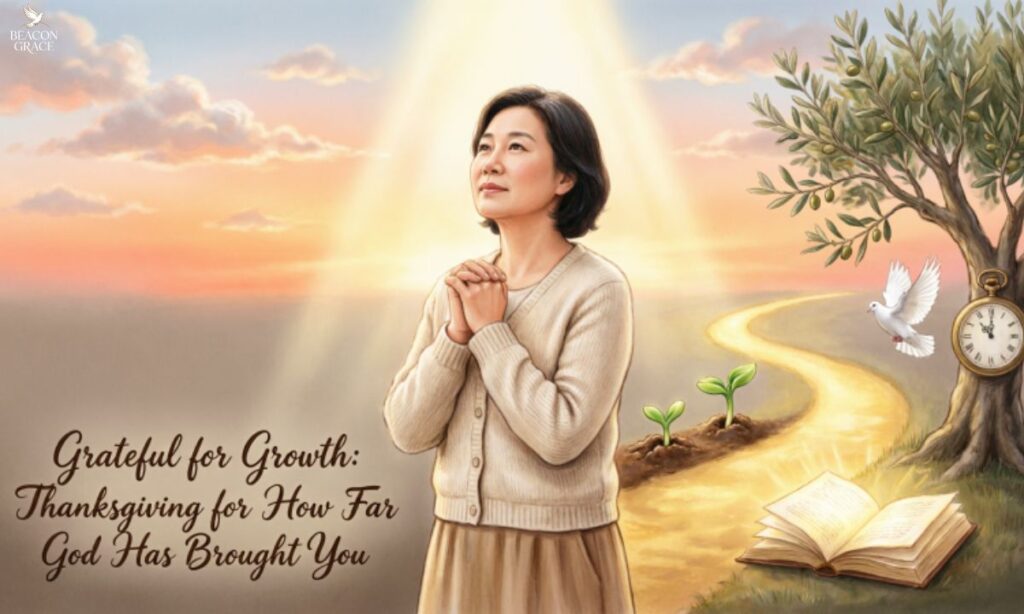
Theme: Appreciating the spiritual progress God has worked in us
Key Bible Verse: Being confident of this, that he who began a good work in you will carry it on to completion until the day of Christ Jesus. Philippians 1:6
Core Message: We’re not who we used to be, and we’re not yet who we’ll become. Gratitude for growth acknowledges both truths, celebrating progress while remaining humble about the journey ahead. When we thank God for how He’s changed us, we build faith that He’ll continue the transformation.
Sample Mini Sermon:
One of my favorite spiritual practices is looking back. Not dwelling on the past, but reflecting on how God has worked in my life over years. When I do this honestly, I’m amazed. I see patterns of growth I didn’t notice while I was in them. I see how God used seasons I thought were wasted. I see transformation I couldn’t have accomplished on my own.
Paul reminds us that God is committed to completing the work He started in us. This is hugely encouraging. It means our growth isn’t dependent on our willpower alone. God is actively working, shaping, refining. And He won’t give up until we’re complete in Christ.
But here’s what I’ve learned: we have to notice the growth to be grateful for it. If we’re only focused on how far we still have to go, we’ll miss how far we’ve already come.
Five years ago, I struggled with anxiety that crippled me. I couldn’t sleep. I couldn’t make decisions. I was paralyzed by what-ifs. And while I’m not perfectly free of anxiety today, I’m so much better. I’ve learned to take thoughts captive. I’ve developed practices that ground me. I’ve experienced God’s peace in ways I never knew were possible.
I could focus on the fact that I still struggle sometimes. Or I can be grateful for how much God has healed and how much I’ve grown. That gratitude fuels hope for continued transformation.
The same is true for you. Maybe you used to have a terrible temper, and now you can catch yourself before exploding. Maybe you struggled with addiction, and you’ve been sober for six months. Maybe you used to never read your Bible, and now you’re in it every day. These are victories worth celebrating.
When we thank God for growth, we’re acknowledging His faithfulness. We’re saying, “You’ve been working in me, and I see it. You haven’t given up on me. You’re making me more like Jesus, one step at a time.
That kind of gratitude builds faith for the journey ahead. If God has brought you this far, He’ll take you further. He who began the work will complete it.
Weekly Challenge: Write down three specific ways you’ve grown spiritually in the past year. Thank God for each one and ask Him to continue the work.
Thankful for Interruptions: Gratitude for Divine Appointments Disguised as Disruptions
Theme: Seeing God’s hand in unexpected interruptions to our plans
Key Bible Verse: In their hearts humans plan their course, but the Lord establishes their steps.Proverbs 16:9
Core Message: We make plans, but God directs our steps, often through interruptions. What feels like disruption may actually be a divine appointment. Gratitude for interruptions requires trust that God’s agenda is better than ours and that He’s orchestrating encounters and opportunities we couldn’t plan ourselves.
Sample Mini Sermon:
I used to hate interruptions. I’m a planner. I make lists. I schedule my days. And when something unexpected derails my plan, I get frustrated. Or at least I used to.
Then I started noticing something. Some of my most significant ministry moments happened through interruptions. The person who stopped me after church with an urgent need. The phone call that came right when I was sitting down to work. The unexpected visit from someone struggling. At the moment, these felt like inconveniences. Looking back, they were divine appointments.
Jesus modeled this constantly. He was on His way to heal Jairus’s daughter when a woman with a bleeding disorder interrupted Him. He could have said, “Not now, I’m busy with something important.” But he stopped. He was engaged. He healed her. Then He continued to Jairus’s house and raised his daughter from the dead. Both encounters mattered.
What if we started viewing interruptions differently? What if, instead of resenting them, we asked, God, did You arrange this? Is there a reason this person crossed my path right now? Is there something you want me to see or do that I wouldn’t have noticed if my plan had gone smoothly.
I have a friend who was rushing to an appointment when his car broke down. He was furious. But the tow truck driver who came turned out to be searching for meaning in life. My friend ended up sharing the gospel with him. That man gave his life to Christ. The interruption was the whole reason my friend was put in that situation.
Proverbs tells us that we plan our course, but God establishes our steps. Sometimes His establishing looks like redirection. Interrupting. Rerouting. And when we’re grateful for His guidance instead of resistant to His changes, we get to participate in things we never could have planned.
This doesn’t mean every interruption is divine or that we should be available for everything and everyone all the time. It means we hold our plans loosely and stay sensitive to God’s leading, even when it disrupts our agenda.
Weekly Challenge: This week, when your plans get interrupted, pause before reacting. Ask God if He’s orchestrating something you need to pay attention to.
Grateful for Spiritual Gifts: Thankfulness for How God Has Equipped You
Theme: Appreciating the specific spiritual gifts God has given for building His kingdom
Key Bible Verse: “There are different kinds of gifts, but the same Spirit distributes them. There are different kinds of service, but the same Lord. There are different kinds of working, but in all of them and in everyone it is the same God at work.1 Corinthians 12:4-6
Core Message: God has equipped every believer with spiritual gifts, not for self-promotion, but for serving others and building up the church. Gratitude for our gifts prevents pride (they’re God-given, not self-earned) and releases us to use them freely without comparison to how others are gifted.
Sample Mini Sermon:
The church functions like a body, and every part matters. Paul’s analogy in 1 Corinthians is brilliant. The eye can’t say to the hand, I don’t need you. The head can’t say to the feet, “You’re not important.” Every member has a function, and every function is necessary.
But here’s where we get tripped up. We compare gifts. We rank them. We think some are more valuable than others. We envy people with public gifts and overlook people with behind-the-scenes gifts. And in the process, we miss the whole point.
Spiritual gifts aren’t rewards for being super-spiritual. They’re tools God distributes for building His kingdom. You didn’t earn them, He gave them. And He gave them strategically, equipping you for specific purposes He designed you to fulfill.
I have a friend with an extraordinary gift of mercy. She feels people’s pain deeply and knows exactly how to comfort them. She’s not a great public speaker. She doesn’t lead worship. She doesn’t teach. But when someone is hurting, she’s the first person they call. And through her gift, countless people have experienced God’s comfort.
For years, she felt inadequate because her gift wasn’t up front. But when she started being grateful for how God had wired her and stopped wishing she had different gifts, she became incredibly effective. She stopped comparing and started contributing.
That’s what gratitude for spiritual gifts does. It frees us to be who God made us to be. It releases us from envy and competition. It helps us celebrate others’ gifts instead of resenting them. And it empowers us to serve freely, knowing that our contribution matters.
If you don’t know your spiritual gifts, ask God to reveal them. Pay attention to what comes naturally to you, what gives you energy when you do it, what others consistently affirm in you. Then thank God for those gifts and look for ways to use them for His glory and others’ good.
Weekly Challenge: Identify one spiritual gift you believe God has given you. Thank Him for it and find one specific way to use it to serve someone this week.
Thankful for Honest Friendships: Gratitude for People Who Tell Us the Truth
Theme: Appreciating relationships where truth and accountability flourish
Key Bible Verse: Wounds from a friend can be trusted, but an enemy multiplies kisses. Proverbs 27:6
Core Message: True friends love us enough to tell us hard truths. Flattery is easy; honesty requires courage and love. Gratitude for honest friendships acknowledges that people who challenge us, correct us, and hold us accountable are gifts from God, even when their words sting.
Sample Mini Sermon:
Everybody wants friends who make them feel good. But what we need are friends who make us better. There’s a huge difference.
Proverbs gives us this striking image: Wounds from a friend can be trusted, but an enemy multiplies kisses. In other words, someone who flatters you but never challenges you is not acting like a friend, they’re acting like an enemy. They’re keeping you comfortable in patterns that harm you. But a true friend will wound you if necessary, speaking the truth that hurts in the moment but heals in the long run.
I have a few friends who have permission to speak hard truths into my life. They know me well enough to see my blind spots. They love me enough to say difficult things. And they’re humble enough to receive corrections from me as well. These relationships are sacred, and I’m profoundly grateful for them.
One of these friends once called me out on how I was treating my staff. He said, You’re leading from insecurity right now, and it’s making you controlling and critical. You need to repent and change course. It stung. My first reaction was defensiveness. But I knew he was right. His honesty saved me from damaging important relationships and allowed me to address root issues I’d been avoiding.
That’s what honest friendship does. It doesn’t let you stay stuck. It doesn’t enable your dysfunction. It loves you enough to speak the truth, even when it’s uncomfortable.
But here’s the key: we have to be grateful for these relationships. If we resent correction or distance ourselves from people who challenge us, we’ll surround ourselves with yes-men who tell us what we want to hear. And we’ll stop growing.
Gratitude for honest friendships means thanking God for people who love you enough to be truthful, even when it costs them something. It means valuing substance over flattery. It means recognizing that the people who make you uncomfortable sometimes are often the ones making you better.
Weekly Challenge: Thank a friend who has spoken the hard truth to you in the past. Tell them you’re grateful for their honesty and their willingness to love you that way.
Grateful for Mysteries: Thanksgiving for What We Don’t Understand
Theme: Finding peace and gratitude in accepting God’s mysteries
Key Bible Verse: The secret things belong to the Lord our God, but the things revealed belong to us and to our children forever, that we may follow all the words of this law. Deuteronomy 29:29
Core Message: We don’t have to understand everything to trust God. Some things are meant to remain mysteries, and gratitude for mystery is trust in God’s wisdom. When we stop demanding answers and start trusting God’s character, we find peace that transcends understanding.
Sample Mini Sermon:
We live in an age that demands answers. We Google everything. We expect explanations. We struggle with ambiguity. And we bring that same expectation to our faith. We want to understand why God allows suffering, why prayers go unanswered, why good people experience terrible things.
But Deuteronomy reminds us that some things belong to God alone. There are secret things, mysteries we’re not meant to fully understand this side of heaven. And that’s okay.
This doesn’t mean we shouldn’t ask questions or wrestle with difficult things. Job questioned God extensively. David poured out his confusion in the Psalms. Habakkuk demanded answers. God can handle our questions. But there comes a point where we have to accept that we won’t always get the answers we want, and we have to choose to trust anyway.
I watched a mother bury her child. It was one of the most excruciating experiences of my ministry. And she asked the question everyone was thinking: “Why?” Why would God allow this? Why didn’t he intervene? Why would a good God let something so terrible happen?
I didn’t have answers. I couldn’t explain it in a way that made sense. But I watched her choose gratitude anyway, not for the tragedy, but for the time she had with her daughter, for the love they shared, for the hope of reunion in heaven, for God’s presence in the darkest valley.
She told me months later, “I had to accept that I might never understand why this happened. But I can be grateful that God is with me in it. I can trust His character even when I can’t trace His hand.
That’s mature faith. That’s gratitude for mystery. It says, I don’t understand, but I trust you. I don’t have answers, but I have You. And you are enough.
Weekly Challenge: Identify one thing about God or your life that confuses you. Instead of demanding answers, thank God for His wisdom that surpasses your understanding.
Summary Framework:
Grateful for Seasons: Thanksgiving for different life seasons and their unique purposes
- Key Verse: Ecclesiastes 3:1 There is a time for everything, and a season for every activity under the heavens.
Thankful for Boundaries: Gratitude for healthy limits that protect us
- Key Verse: Proverbs 4:23 Above all else, guard your heart, for everything you do flows from it.
Grateful for Hope: Thanksgiving for the anchor of hope in Christ
- Key Verse: Hebrews 6:19 We have this hope as an anchor for the soul, firm and secure.
Thankful for Conviction: Gratitude for the Holy Spirit’s work of conviction
- Key Verse: John 16:8 When he comes, he will prove the world to be in the wrong about sin and righteousness and judgment.
The Grateful Legacy: Passing thanksgiving to the next generation
- Key Verse: Psalm 78:4 We will tell the next generation the praiseworthy deeds of the Lord, his power, and the wonders he has done.
Frequently Asked Questions
How long should a short Thanksgiving sermon be
A short sermon typically runs 10-15 minutes, allowing you to develop one main point with a clear application without losing your congregation’s attention. Focus on depth rather than breadth.
Can I adapt these outlines for different audiences
Absolutely. These outlines are frameworks. Adapt the language, examples, and applications for youth groups, senior adults, small groups, or specific cultural contexts while keeping the biblical foundation intact.
What if my congregation struggles with gratitude during hard times
Acknowledge the difficulty honestly. Don’t rush to gratitude or make it sound easy. Validate pain while pointing to God’s presence in it. Gratitude in suffering is a process, not an instant fix.
How do I make gratitude sermons practical, not just emotional
Include specific, actionable steps. Don’t just tell people to “be grateful, give them tools like gratitude journals, specific prayer practices, or concrete ways to express thanksgiving to God and others.
Should every Thanksgiving sermon include communion
While not required, communion naturally connects to thanksgiving themes. If it fits your tradition and the sermon content, it can be a powerful way to practice gratitude for Christ’s sacrifice.
How do I address people who feel they have nothing to be thankful for
Start with the basics: breath, life, God’s presence. Acknowledge that gratitude can feel impossible in deep pain, but it’s not about denying reality, it’s about finding God in it.
Can I use these outlines for non-Thanksgiving services
Yes! Gratitude is relevant year-round. These messages work for any service where you want to cultivate thankfulness in your congregation.
What’s the best way to prepare a congregation for a gratitude message
Consider asking people to bring written testimonies of God’s faithfulness, or create a gratitude wall where people can post thanksgiving notes before the service. This prepares hearts to receive the message.
How do I balance gratitude with lament
Scripture holds both. Don’t ignore pain or suffering in pursuit of gratitude. Show how thanksgiving and lament can coexist, how we can grieve what’s wrong while thanking God for His presence and promises.
What if I’m struggling with gratitude myself as I prepare to preach
Be honest with God about it. Sometimes the sermon we need to preach is the one we need to hear. Your own wrestling can make your message more authentic and relatable.
Closing Thoughts
As we close these thirty reflections on thanksgiving, I want to leave you with a truth that has marked my life and ministry: gratitude changes everything. Not because it makes problems disappear or because it’s a magical formula for getting what we want, but because it fundamentally reorients our hearts toward God.
I’ve watched gratitude save marriages that seemed beyond repair. When couples stopped focusing on what their spouse wasn’t doing and started thanking God for what they were doing, softness returned. Appreciation rekindled. Love that had grown cold warmed again. Not because the problems vanished, but because gratitude created space for grace to work.
I’ve seen thankfulness heal wounds that counseling couldn’t touch. People who had every reason to be bitter, who had suffered abuse, injustice, profound loss, found freedom when they chose to thank God for His presence in their pain, for strength to survive, for hope that healing was possible. Gratitude didn’t erase their scars, but it transformed those scars from badges of victimhood into testimonies of God’s sustaining grace.
I’ve witnessed gratitude break the chains of anxiety and depression. When people who were drowning in despair started the simple practice of naming things they were grateful for each day, light began piercing their darkness. Not overnight. Not easily. But gradually, as they trained their eyes to see good alongside the hard, hope returned. Joy flickered back to life. The darkness that had seemed absolute began to recede.
This is the power of thanksgiving. It’s not denial. It’s not pretending. It’s not toxic positivity that ignores real pain. It’s the courageous choice to see God’s hand in our lives even when circumstances are difficult. It’s the declaration that no matter what we’re facing, God is good, God is present, and God is at work.
As you use these sermon outlines to shepherd your congregation, pray that God would do more than just inspire them to feel grateful for a moment. Pray that He would ignite a revolution of thanksgiving that transforms how they see everything. Pray that gratitude would become not just something they do during a holiday, but who they are year-round.
Because here’s what I’ve learned after decades in ministry: grateful people change the world. They bring light into darkness. They speak hope into despair. They love when others grow bitter. They give when others hoard. They trust when others fear. They worship when others complain. And through them, God’s kingdom advances in ways that force and argument never could.
May you preach these messages with conviction. May your congregation catch the fire of genuine thanksgiving. And may the spirit of gratitude that you cultivate in your church family overflow into your community, your city, and beyond, until people see the joy of the Lord in you and want what you have.
This Thanksgiving season and always, may we be a people marked by profound, transformative, unstoppable gratitude. Not because we’ve been given everything we want, but because we’ve been given everything we need in Christ. And that, dear friends, is worth celebrating every single day of our lives.
Grace and peace to you as you shepherd God’s people into deeper thanksgiving. May the Lord bless your preparation, anoint your proclamation, and multiply the fruit of these messages in ways that exceed anything you can ask or imagine.

Samuel Knox is a passionate content creator with 4 years of experience writing blogs on blessings, Bible verses, and prayers. Currently, he contributes his expertise at Beacongrace.com, inspiring readers through faith-based content