

There’s a version of Lucifer most people know. Red skin. Horns curling from his forehead. A pitchfork. A menacing grin. He shows up in horror movies, Halloween costumes, and about a thousand pieces of medieval artwork. He’s become almost. cartoonish.
And here’s the uncomfortable truth, almost none of that is in the Bible.
Not the red skin. Not the horns. Not the pitchfork. Not even, technically, the name “Lucifer” as a proper name.
What Scripture actually describes is something far stranger, far more beautiful, and honestly far more terrifying than any of the cultural myths we’ve inherited. The biblically accurate Lucifer is a being of breathtaking glory “the seal of perfection,” full of wisdom, perfect in beauty, an anointed guardian cherub who walked among fiery stones on God’s holy mountain. And then he made a choice. Five words: I will. I will. I will.
That choice, according to Scripture, fractured heaven itself.
This article digs into what the Bible actually says, the original Hebrew, the theological debates, the composite picture built across Isaiah, Ezekiel, and Revelation and separates it from centuries of artistic, cultural, and literary embellishment. Whether you’re a serious Bible student, a curious skeptic, or someone who just got into a rabbit hole at 2 AM, this is worth understanding.
The Name “Lucifer” — A Translation Problem That Changed Everything
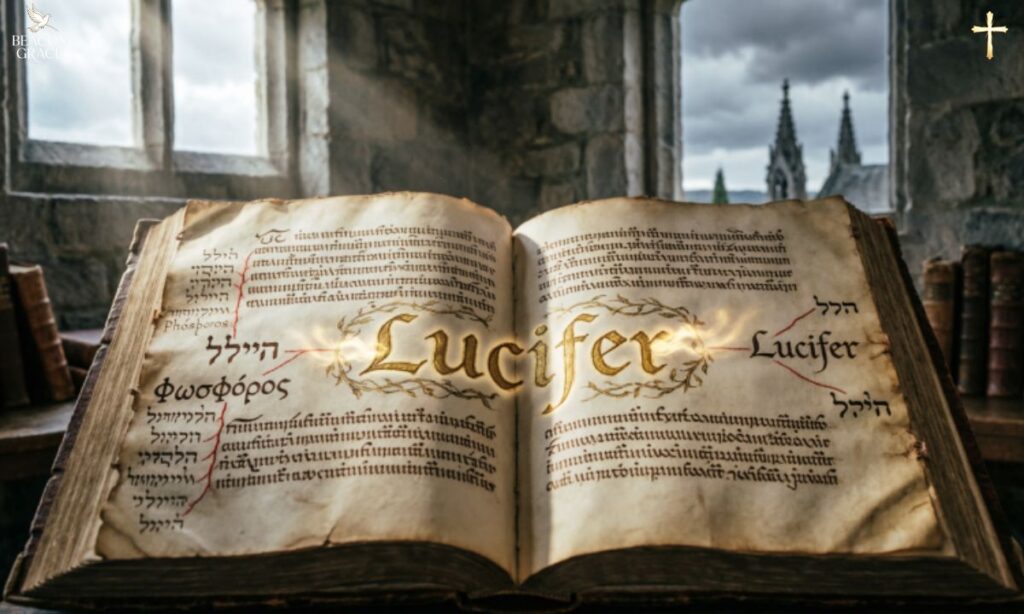
Let’s start at the very beginning, because the word “Lucifer” itself is the source of enormous confusion.
The word appears in the Bible exactly once in Isaiah 14:12. It’s a Latin term, Lūcifer, meaning light-bringer or “morning star. It was introduced through Jerome’s 4th-century Latin translation of the Bible, known as the Vulgate, where it was used to translate the Hebrew word Helel ben Shahar, meaning “Shining One, Son of the Morning.
So right away we’re dealing with a translation of a translation. The KJV translators inherited Jerome’s Latin and rendered it into English as the proper name Lucifer which is what most English-speaking Christians grew up reading. But the underlying Hebrew doesn’t use a name at all.
The Hebrew term helēl appears nowhere else in the Old Testament. Many scholars understand it as a reference to Venus the planet sometimes called the morning star which is an exceptionally bright point in the night sky, one of the last to be washed out by rising daylight.
Think about that imagery for a second. The morning star shines brilliantly before dawn. It seems, in that dark pre-sunrise hour, like it might be the brightest thing in the sky. And then the sun rises — and the morning star vanishes into insignificance. That’s the metaphor Isaiah is deploying. And it’s far more poetically powerful than “red devil with a pitchfork” ever was.
Why Modern Translations Changed It
Most modern translations NIV, ESV, NASB, NRSV, translate the underlying Hebrew Helel as “morning star,day star, or shining one, which more accurately conveys the original meaning. Modern translators generally prefer providing the meaning rather than perpetuating a Latin term that English readers might misunderstand as a proper name.
The New King James Version (NKJV) kept Lucifer for continuity with the KJV tradition, and some defenders argue this is actually clearer since morning star is also a title applied to Jesus in Revelation 22:16. That’s a fair point, and it’s the source of genuine scholarly debate. But linguistically, Lucifer as a name for a specific being is more a product of tradition than of the original text.
Here’s what that means practically: when you read Lucifer in most older English Bibles, you’re reading a Latin word that was chosen to describe a concept, not a Hebrew proper name. The being described didn’t go by Lucifer he went by Shining One, and the name stuck through centuries of theological interpretation.
What Did Lucifer Actually Look Like? The Biblical Description
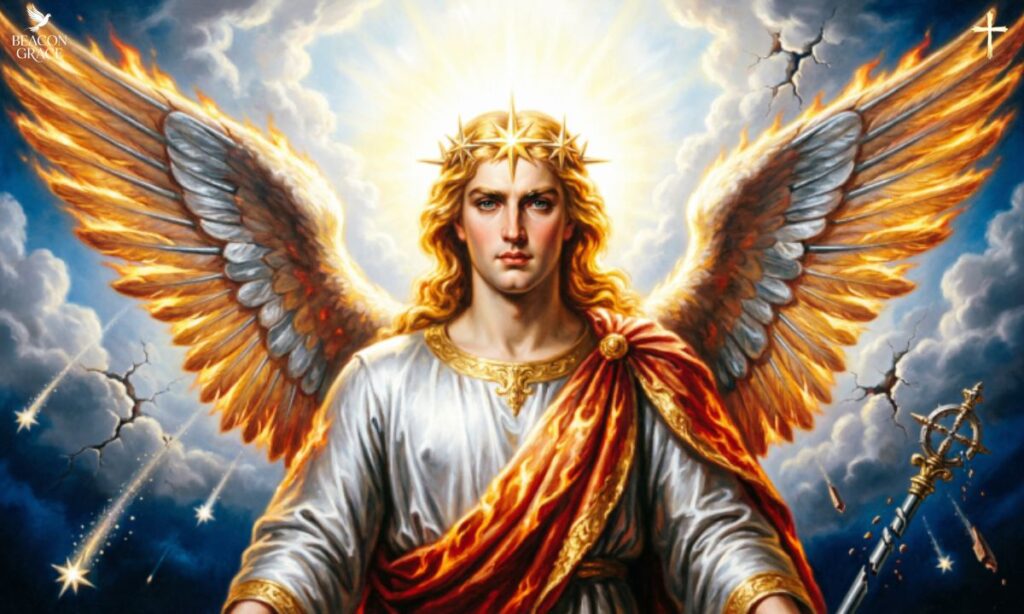
Forget the red costume. The Bible, when it does describe this being’s appearance, paints something extraordinary, and deeply unsettling in the best possible way.
The primary passage describing his original appearance is Ezekiel 28:12-17, though it’s addressed formally to the king of Tyre. Most theologians recognize this as a dual reference text one that speaks to a human king on the surface while pointing to a cosmic reality beneath. The language simply goes beyond anything that could describe a mortal ruler.
He was an anointed guardian cherub covered with nine precious stones, carnelian, topaz, diamond, beryl, onyx, jasper, sapphire, emerald, and carbuncle, set in gold. He walked among fiery stones on God’s holy mountain.
Let that sink in. This isn’t a monster. This is a being adorned with gemstones, shining and radiant, walking in the presence of God. The language anointed guardian cherub places him in the highest tier of angelic hierarchy, not some mid-level spirit, but one of the beings positioned closest to God’s throne.
What Is a Cherub, Really
Popular culture has turned cherubs into chubby, rosy-cheeked baby angels on Valentine’s Day cards. The biblical cherubim are nothing like that.
In Ezekiel 10, cherubim are described as four-faced beings with multiple wings and forms that seem almost overwhelmingly complex, fire moving between them, wheels spinning alongside them, radiating light. They’re the creatures that guard the throne of God. They are, in a word, terrifying in the best sense. Awe-inspiring.
So when the text describes Lucifer as the anointed cherub who covers this is an elite being. The peak of created angelic existence. And Scripture provides no description of his appearance after his fall. As a spirit being (Ephesians 6:12), he appears to have no fixed physical form, though 2 Corinthians 11:14 indicates he can appear as an angel of light.
The red devil with horns? That image has no biblical basis, originating instead from medieval art and folklore. It’s a compelling cultural invention, but it’s not Scripture.
Isaiah 14: The Taunt Song and the Five I Wills
Isaiah 14 is a fascinating, layered piece of ancient Hebrew poetry. On the surface, it’s a taunt song written for Israel to sing over the fallen king of Babylon, a kind of prophetic victory anthem. But embedded within it is the most famous description of spiritual pride in all of Scripture.
Isaiah 14:13-14 records what theologians have called the most dangerous words ever spoken in heaven. Five times, this being declared I will each declaration a direct act of rebellion against God. These were not random thoughts. They were a deliberate choice to place self above the Creator.
Here’s what those five declarations were:
- I will ascend to heaven the desire to leave his appointed position
- I will raise my throne above the stars of God the desire for authority over other angels
- I will sit enthroned on the mount of assembly a claim to divine governance
- I will ascend above the tops of the clouds a claim to transcend the created order
- I will make myself like the Most High the ultimate declaration: self-deification
Notice the progression. It’s not just ambition, it’s a systematic, deliberate attempt to replace God entirely. Each I will builds on the last. And the response? Yet thou shalt be brought down to hell, to the sides of the pit (Isaiah 14:15, KJV).
The contrast is devastating. Five declarations of ascending, one swift verdict of descent.
Was Isaiah Really Talking About a Fallen Angel?
This is where scholars genuinely diverge, and it’s worth being honest about it.
Protestant Reformers John Calvin and Martin Luther explicitly rejected the equation, arguing Isaiah 14 refers to a human king using cosmic metaphor. However, later Christian tradition, beginning with early Church Fathers like Origen, connected Isaiah 14:12 and Ezekiel 28:12-17 with Revelation 12:7-9 to create a composite narrative of angelic rebellion.
The New Testament does offer some connective tissue. In Luke 10:18, Jesus tells his disciples: I saw Satan fall like lightning from heaven. That statement, combined with the imagery in Revelation 12 and the language of Isaiah 14, forms the basis for the traditional identification. But it’s a theological construction built across multiple texts, not a single clear verse.
That’s not necessarily a problem. Systematic theology often works by connecting dots across Scripture. But it’s worth knowing you’re dealing with a composite picture, not a single direct statement.
Ezekiel 28: The Most Detailed Portrait
While Isaiah gives us the pride narrative, Ezekiel 28 gives us the portrait. And it’s remarkable.
Ezekiel records: You were the seal of perfection, full of wisdom and perfect in beauty. You were in Eden, the garden of God. You were the anointed cherub who covers; I established you. You were on the holy mountain of God; you walked back and forth in the midst of fiery stones. You were perfect in your ways from the day you were created, till iniquity was found in you.
“Perfect in your ways from the day you were created. Think about that phrase. This wasn’t a flawed being who was always going to fail. This was a genuinely perfect creation who made a genuine choice. The fall isn’t destiny, it’s a decision.
That’s actually the most theologically disturbing part of the story. It’s not “he was always bad. It’s “he was perfect, and he chose this anyway.
The text also mentions Eden, which is interesting, because it potentially connects this being to the serpent narrative in Genesis 3. That connection has been made throughout church history, though it’s another inference rather than an explicit biblical statement.
Lucifer vs. Satan: Are They the Same Being
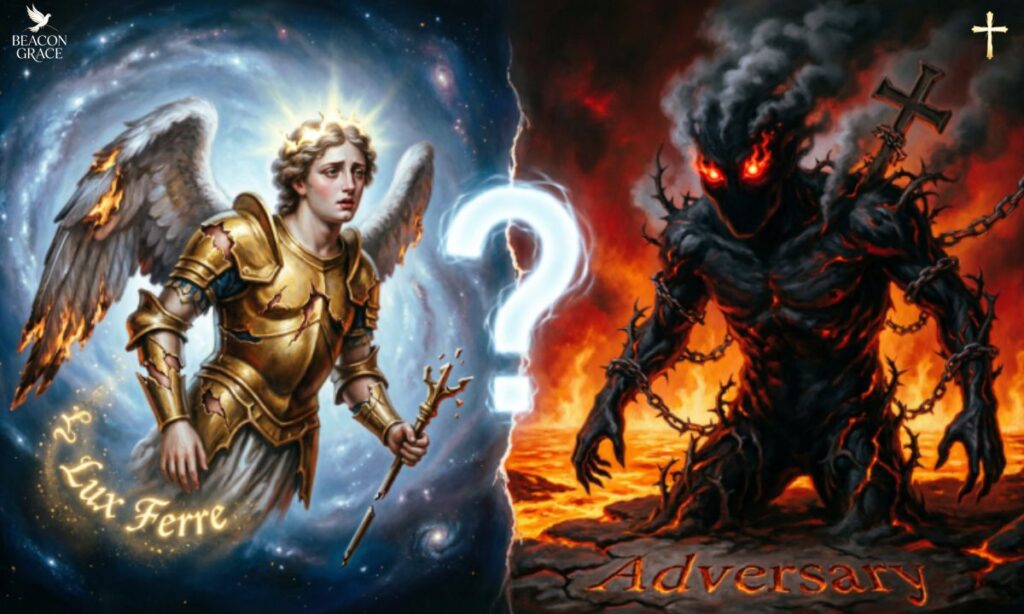
This question comes up constantly, and the answer is more nuanced than most people realize.
The Bible never explicitly equates Lucifer and Satan. Lucifer appears only once in the Bible (Isaiah 14:12, KJV), in a passage directed at the King of Babylon. Satan (meaning adversary) appears 58 times throughout Scripture.
The traditional understanding, held by most mainstream Christian denominations, is that they are the same being at different stages. Lucifer describes what he was before the fall, a being of light and glory. Satan describes what he became after it. The fall changed everything.
But there’s a minority scholarly view, represented by people like John Calvin, that sees Lucifer purely as a metaphor for the king of Babylon’s arrogance. On this reading, there’s no fallen angel named Lucifer at all, just a cosmic metaphor for human pride.
Most evangelical and Catholic theologians hold the composite view: Isaiah 14 and Ezekiel 28 describe, through layers of dual-reference prophecy, the original fall of the being who later appears throughout Scripture as Satan the adversary, the accuser in Job, the tempter in the wilderness, the dragon in Revelation.
The simplest way to understand the distinction: if the traditional interpretation is correct, Lucifer is a description of what he was, and Satan is the name of what he became.
The Fall: When and How Did It Happen?
Here’s a surprise for many people the Bible doesn’t give us a clear timeline.
Nowhere in Scripture does it say before Day 1 of creation, Lucifer fell. The fall is described in poetic and apocalyptic language, not chronological narrative. What we can piece together from the composite picture:
- The fall appears to predate human history, since a tempter is present in Eden (Genesis 3)
- Revelation 12:7-9 describes a war in heaven where the dragon and his angels were cast down, though interpreters debate whether this is a description of the primordial fall or an end-times event
- Jesus’ statement in Luke 10:18 (I saw Satan fall like lightning from heaven seems to reference an event Jesus personally witnessed, though whether that’s past or symbolic is debated
What’s clear is the why. In short, Lucifer was described as the morning star as a reflection of his character. This morning star became deceived, believing he could rise above God, and from then on he would be known as the devil, which means slanderer, and Satan, which means adversary both of which fit his new nature perfectly.
The Morning Star Paradox: Why Both Jesus and Lucifer Share the Title
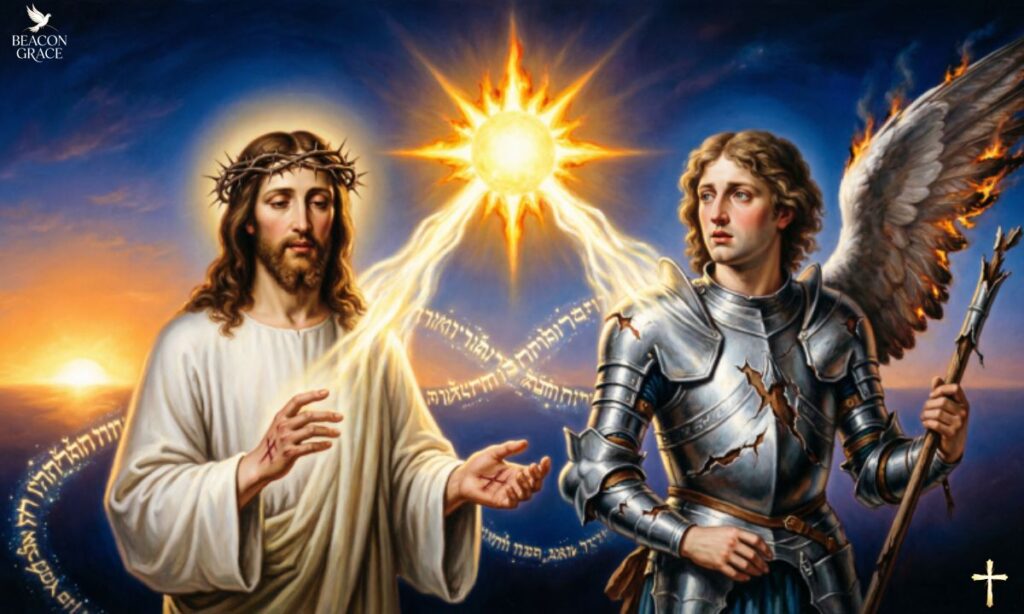
This one genuinely trips people up, and it’s worth addressing directly.
In Revelation 22:16, Jesus identifies himself as the morning star. In Isaiah 14:12, the title morning star appears to be associated with the fallen figure. Why would both Jesus and Satan be described using the same term?
The answer lies in understanding how biblical metaphor works. The morning star is Venus, brilliant, appearing just before dawn. The image doesn’t belong exclusively to one being. It’s a description of radiant, light-bearing glory. Jesus claims it in its fullest and truest sense, as the true light. The morning star imagery for Lucifer represents him in his former unfallen state, what he was before his rebellion, a reflection of his original glory.
Some theologians go further: the irony is intentional. The being who tried to claim divine glory through pride lost everything. The being who is actually divine,Jesus, humbly took on flesh, died, and was raised. One grasped for glory; one laid it down. And the morning star title ultimately belongs to the one who laid it down.
What the Bible Doesn’t Say About Lucifer (Common Misconceptions)
Let’s just run through some of the most persistent myths:
Lucifer rules hell. The Bible doesn’t teach this. Revelation describes the devil being cast into the lake of fire (Revelation 20:10) he’s a prisoner of hell, not its ruler. The idea of Satan sitting on a dark throne comes from Dante and Milton, not Scripture.
Lucifer has horns, a tail, and carries a pitchfork. Zero biblical basis. Medieval European art, influenced by depictions of pagan gods like Pan, created this image. It’s culturally sticky, but theologically empty.
Lucifer’s fall happened because he was jealous of humans. Some church fathers proposed this, but it’s not in the biblical text. The text in Isaiah clearly attributes the fall to pride and the desire to be like God no mention of humans.
Lucifer is in charge of demons. The Bible presents Satan as the ruler of the kingdom of the air” (Ephesians 2:2) and the god of this age (2 Corinthians 4:4), which suggests authority over fallen spiritual forces. But the organizational structure of evil in the biblical cosmology is never laid out with corporate-org-chart clarity.
Lucifer can read your mind. The Bible never attributes omniscience to Satan. Only God is omniscient. Satan is powerful and ancient, but he’s still a created, finite being.
The Theological Significance: Why This Story Is in the Bible
Here’s the thing that often gets lost in the debates about translation and theology, the reason these passages exist in Scripture.
The story of Lucifer is ultimately a lesson written for humanity. If pride could destroy the most glorious being God ever created, it can destroy anyone. The Bible uses his fall as the ultimate warning against placing self above God in any area of life.
Proverbs 16:18 says: “Pride goes before destruction, a haughty spirit before a fall.” The story of Lucifer is the illustration behind that proverb. He’s not in Scripture primarily to satisfy our curiosity about the spirit world, he’s there as a mirror.
His role functions as a theological anchor for understanding the origin of pride, the nature of spiritual rebellion, and the cosmic consequences of choosing self over God.
Just as the morning star briefly outshines everything before the sun renders it invisible, Lucifer’s brilliance existed only in the shadow of God’s greater light. The moment he stopped acknowledging that shadow, he fell.
That’s a message that doesn’t age. The same pride that drove five I will declarations in heaven drives human behavior every single day.
Pros and Cons of Common Interpretive Approaches
It’s worth being transparent: there are genuine disagreements among serious Bible scholars about how to read these texts. Here’s an honest breakdown:
The Traditional View (Literal Fallen Angel)
Pros:
- Consistent with the majority of church history
- Supported by New Testament connections (Luke 10:18, Revelation 12)
- Explains why Isaiah’s language goes beyond what a human king could represent
- Provides a coherent theology of spiritual warfare (Ephesians 6:12)
Cons:
- Requires connecting texts across books that don’t explicitly reference each other
- Both Isaiah 14 and Ezekiel 28 have clear, literal human subjects (King of Babylon, King of Tyre)
- The name “Lucifer” as a proper name is a translation artifact, not an original Hebrew name
The Metaphorical/Historical View (Human King Only)
Pros:
- Stays closer to the immediate literary context of each passage
- Supported by scholars like Calvin and Luther
- Avoids over-reading cosmic drama into what may be political satire
Cons:
- Struggles to explain Ezekiel 28’s language (“you were in Eden,” “anointed cherub”) for a human king
- Doesn’t naturally integrate with New Testament references to Satan’s fall
- Leaves the origin of evil largely unexplained theologically
Most mainstream Christian theologians, Catholic, Orthodox, and evangelical Protestant, hold some version of the traditional view, while recognizing the texts have multiple layers of meaning.
Practical Takeaways: What the Biblically Accurate Lucifer Teaches Us
You might be wondering: okay, so what do I do with all this? This is where it gets practically useful.
1. Don’t underestimate pride. The fall of the most glorious created being in existence was caused by pride, not ignorance, not weakness, not external temptation. Internal pride. That should make every human being pause.
2. Gifts and calling aren’t the same as character. Lucifer was gifted beyond description. He was appointed, anointed, and positioned near the highest place. None of that protected him when his character failed. Talent and position are never a substitute for humility.
3. The enemy is real, but not omnipotent. Understanding Lucifer biblically keeps you from two equal errors: treating Satan as a cartoon that doesn’t need to be taken seriously, or treating him as an all-powerful being equal to God. He’s neither. He’s a powerful, created being operating under God’s ultimate sovereignty.
4. I will can be a prayer or a rebellion depending on who’s in the center. Five declarations of I will tore heaven. But “not my will, but yours” (Luke 22:42) redeemed it. The same grammatical construction, completely opposite orientation. The difference is everything.
5. Read primary sources. Much of what people “know” about Lucifer comes from John Milton’s Paradise Lost, Dante’s Inferno, or popular entertainment. These are brilliant works, but they’re not Scripture. Go back to Isaiah 14 and Ezekiel 28 and read them slowly, in context.
Frequently Asked Questions About Biblically Accurate Lucifer
Is Lucifer a name or a title?
Technically, a title, or more precisely, a translation artifact. Lucifer is Latin for light-bearer or light-bringer, composed of lux (light) and ferre (to carry/bear). It translates the Hebrew word Helel from Isaiah 14:12, which means shining one or morning star. The Hebrew doesn’t use it as a proper name. It became a proper name through centuries of Christian tradition building on Jerome’s Latin translation.
Was Lucifer an archangel
The Bible doesn’t use the term “archangel” for Lucifer. The text in Ezekiel 28 describes him as an anointed guardian cherub a cherub, not an archangel. Archangels (Michael, Gabriel, Raphael in various traditions) appear to be a separate category of angelic being. That said, “anointed cherub who covers” is clearly a high-ranking position.
Does the Bible say what caused Lucifer’s pride?
No. The text describes the pride but doesn’t explain its origin. Ezekiel 28:17 says: “Your heart was lifted up because of your beauty; you corrupted your wisdom for the sake of your splendor. His beauty, his very gifts, became the source of his downfall. But why beauty produced pride in a being who was otherwise perfect isn’t explained. It’s one of Scripture’s deliberate silences.
Are Lucifer and Satan the same being?
While Christian tradition often treats Lucifer and Satan as the same being, Scripture does not explicitly make this identification. Most mainstream Christian theology holds they are the same being at different stages, Lucifer being what he was before the fall, Satan being what he became. But this is a theological construction, not a single verse that says Lucifer equals Satan.
What does “morning star” mean in relation to Lucifer
It refers to Venus, the planet that appears brightest before dawn, a symbol of brilliance and glory. In Isaiah’s taunt song, calling the king of Babylon (or the fallen being behind him) the morning star was a sharp irony: you thought you were the brightest light, but you’re being plunged into darkness.
What did Lucifer actually look like
Scripture provides no description of his appearance after his fall. Before it, Ezekiel 28 describes him as adorned with nine precious stones and walking among fiery stones on God’s holy mountain. As a cherub, he would have had wings, as cherubim are described with multiple wings in Ezekiel 10. The popular image of a red devil with horns and a pitchfork has no biblical basis.
Why does Revelation describe Satan as a dragon
Apocalyptic literature uses symbolic imagery, not literal description. The “great dragon” in Revelation 12 represents power, destruction, and ancient evil, symbolic language consistent with how apocalyptic texts have always worked. It’s not meant as a physical description any more than Jesus being called a “lamb” means he looks like a sheep.
Where does the idea of Satan ruling hell come from
Primarily from Dante Alighieri’s Inferno (14th century) and John Milton’s Paradise Lost (17th century) both magnificent works of literature that have profoundly shaped Western imagination. But the Bible presents hell as a place of punishment for Satan, not a kingdom he rules. Revelation 20:10 describes him being cast into the lake of fire.
Conclusion
The cartoonish, red-devil version of Lucifer is actually less frightening than the biblical one. A ridiculous horned monster is easy to dismiss. But a being of perfect beauty, extraordinary wisdom, positioned at the pinnacle of creation, who still chose pride over God? That’s terrifying. Because it means the capacity for catastrophic spiritual failure isn’t rooted in being weak or ignorant. It’s rooted in pride. And that’s a very human problem.
The biblically accurate story of Lucifer found in Isaiah 14, Ezekiel 28, and Revelation is far more powerful and personally relevant than centuries of myth, art, and cultural imagination have allowed most people to see. He is not a red-horned monster but Scripture’s supreme warning: pride destroys even the most perfect, and gifts without gratitude become the path to ruin.
The story isn’t really about him. It never was. It’s about what pride does to any created being, cherub or human, when that being stops looking up.
Five “I wills” tore everything apart. One “not my will” put it back together.
That’s the biblical story. And it’s worth reading in full, in context, in the original language if you can manage it, rather than inheriting someone else’s interpretation of someone else’s translation of a Latin word that wasn’t even the original Hebrew.

Samuel Knox is a passionate content creator with 4 years of experience writing blogs on blessings, Bible verses, and prayers. Currently, he contributes his expertise at Beacongrace.com, inspiring readers through faith-based content